Vallabhbhai Parmar: From Record Books to Classrooms — A Lifelong Journey of Art, Innovation and Resilience
The Extraordinary Artist and Art Educator Turning Creativity, Experimentation and Experience Into a Lasting Legacy
 admin
The Extraordinary Artist and Art Educator Turning Creativity, Experimentation and Experience Into a Lasting Legacy
There are artists who create beautiful things.
There are artists who create extraordinary things.
And then there are artists whose work gradually becomes a journey of its own—crossing the boundaries of the studio, entering classrooms, reaching communities and inspiring people far beyond the canvas.
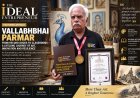
Vallabhbhai Parmar belongs to the third category.
Born on 8 April 1957 in Bhanvad, Saurashtra, Gujarat, Vallabhbhai's relationship with art began during his school years. What initially appeared to be a natural talent for drawing gradually developed into a disciplined artistic pursuit.
Over the decades, that pursuit would take him through formal art education, thousands of creative works, record-setting achievements, exhibitions, awards, educational initiatives and community-oriented programmes.
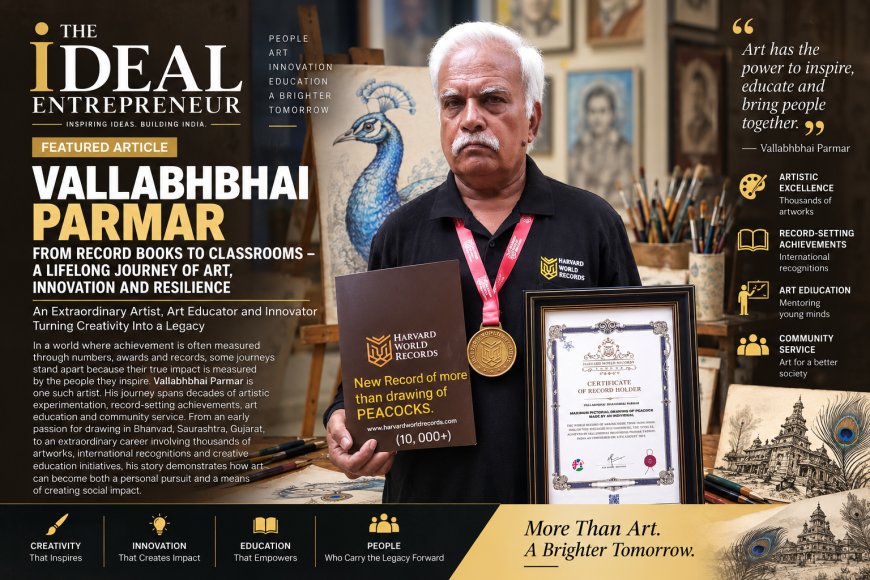
According to his supplied professional profile, he has created more than 38,000 unique peacock paintings, produced more than 12,500 sand sculptures, achieved 66 world records, and received more than 255 national and international awards.
But those numbers tell only one part of the story.
The more interesting story is what happened behind them.
How does an artist continue creating thousands of variations around one subject?
What motivates someone to turn art into a tool for education?
Why would an accomplished artist invest time in teaching children?
And how does creativity help a person continue moving forward after adversity?
The answers can be found in Vallabhbhai Parmar's journey—from a young student in Gujarat to an artist, educator, innovator and community-minded creative whose work has crossed traditional boundaries.
The First Signs of an Artist
Every artistic journey begins somewhere.
For Vallabhbhai Parmar, it began during his school years in Bhanvad.
Drawing was not simply an academic subject for him. It became an area where his natural interest and disciplined effort could come together.
According to the supplied profile, Vallabhbhai achieved first rank in Gujarat in Drawing in the new SSC examination and also performed exceptionally in the Gujarat State Intermediate Drawing Examination.
These early achievements were important because they established something that would remain consistent throughout his career: the combination of creativity and discipline.
Talent can create an opportunity.
Practice turns that opportunity into ability.
And sustained commitment can turn ability into a career.
For Vallabhbhai, those early school achievements became the beginning of a much longer relationship with art.
Choosing Fine Arts as a Path
After demonstrating his ability as a student, Vallabhbhai pursued formal education in fine arts.
He studied at Kala Kendra College of Fine Arts, Vallabh Vidyanagar, where he completed an Art Teacher Diploma.
According to the supplied profile, he secured first rank in the examination.
This stage was important because his relationship with art began to develop in two directions.
One direction was artistic creation.
The other was education.
That combination would eventually become one of the defining characteristics of his professional life.
He would not simply create art.
He would also think about how creativity could be introduced to children and how art could become a meaningful part of education.
When Art Became an Experiment
As Vallabhbhai's career progressed, his artistic practice expanded beyond conventional drawing and painting.
He explored different materials, techniques and forms.
His work has included:
-
Drawing
-
Painting
-
Colour art
-
Sand sculpture
-
Decorative art
-
Craft
-
Experimental art
-
Creative installations
-
Educational art
This willingness to experiment became an important feature of his identity as an artist.
Instead of asking what art was supposed to look like, he repeatedly explored what else it could become.
A canvas could become a space for experimentation.
Sand could become sculpture.
Everyday materials could become creative objects.
And a familiar subject could be reimagined thousands of times.
The 26-Second Drawing
Among the achievements associated with Vallabhbhai Parmar is a particularly unusual artistic feat: a colour drawing completed in just 26 seconds.
Speed drawing may appear simple when described in a single sentence.
In reality, creating a recognisable and aesthetically meaningful artwork within such a short period requires preparation, coordination, confidence and extensive practice.
The hand must move quickly.
The mind must already understand the composition.
Decisions about colour and form have to happen almost instinctively.
The achievement therefore represents more than speed.
It reflects the accumulated experience of an artist who has spent years developing control over his materials and techniques.
According to the supplied profile, the 26-second colour drawing became one of the recognitions associated with his wider record-setting artistic journey.
From One Achievement to a Record-Building Journey
One record can be an achievement.
A long series of records suggests a continuing philosophy of experimentation.
According to Vallabhbhai's supplied profile, he holds 66 world records with gold medals.
The profile associates these achievements with a number of record publications, including:
-
Guinness Book
-
Limca Book
-
Harvard Book
-
Asian Book
-
London Book
-
USA Book
-
Dubai Book
-
India Book
-
Other record publications
The individual record categories should be independently verified against the respective record organisations when formal documentation is required.
But within the supplied narrative, these records form an important part of Vallabhbhai's artistic journey.
They represent his repeated willingness to challenge himself creatively.
Rather than treating one achievement as an endpoint, he continued exploring new possibilities.
More Than 255 Awards
Records form only one part of the story.
According to the supplied profile, Vallabhbhai Parmar has received more than 255 national and international awards.
Among the honours and recognitions listed in his professional material are:
Kala Bhushan Award
Kalashree Award
SAARC Brilliance Award
Ayodhya Kala Ratna
The profile also mentions recognitions associated with major artistic traditions and figures such as Pablo Picasso, Salvador Dalí, Vincent van Gogh, Raja Ravi Varma and Nandalal Bose.
These awards and recognitions are presented according to the supplied professional profile and have not been independently verified for this article.
For Vallabhbhai, however, recognition appears to have been part of a much larger process.
The central motivation remained creativity.
The Peacock: One Subject, Thousands of Possibilities
Perhaps the most remarkable chapter of Vallabhbhai's artistic journey is his work with the peacock.
The peacock is India's national bird, and its colours, feathers and distinctive form provide a naturally rich artistic subject.
But creating one peacock painting is very different from creating thousands.
According to the supplied profile, Vallabhbhai has created more than 38,000 unique peacock paintings.
The word unique is important within the supplied description.
The works are described as varying through elements such as:
-
Colour
-
Design
-
Technique
-
Composition
-
Presentation
The challenge was therefore not simply to reproduce a familiar image.
It was to repeatedly reinterpret it.
The Art of Seeing the Same Subject Differently
There is a deeper creative idea hidden inside Vallabhbhai's peacock paintings.
Creativity is often associated with constantly finding new subjects.
But another form of creativity is learning to see the same subject differently.
A peacock can be colourful.
It can be abstract.
It can be decorative.
It can become geometric.
It can be simplified.
It can be transformed through materials, textures and patterns.
By repeatedly returning to the same central subject, Vallabhbhai's work demonstrates how variation can emerge from observation and experimentation.
The peacock became not a limitation but an artistic universe.
38,000 Paintings and the Discipline Behind Them
Creating thousands of artworks requires more than inspiration.
It requires discipline.
There are days when inspiration comes naturally.
There are also days when creativity requires effort.
For an artist working at such scale, the ability to continue experimenting becomes as important as the ability to create a single impressive work.
The large number associated with Vallabhbhai's peacock paintings therefore represents a long-term commitment to artistic practice.
It reflects repetition, experimentation and the willingness to keep asking:
What else can this become?
From Canvas to Sand
Vallabhbhai's creativity did not remain limited to canvas.
Another major area of his work has been sand art.
According to his profile, he has created more than 12,500 sand sculptures.
The works have included decorative and functional creative objects such as:
-
Home décor
-
Paperweights
-
Garden installations
-
Night lamps
-
Key stands
-
Artistic souvenirs
-
Decorative sculptures
Sand introduced a completely different set of artistic challenges.
Unlike a conventional canvas, sand has its own texture and structural limitations.
The material itself becomes part of the creative process.
Turning an Ordinary Material Into Art
One of the recurring themes in Vallabhbhai's career is the transformation of ordinary materials into creative experiences.
Sand is widely available.
But the artist determines what it can become.
Through technique and imagination, an everyday material can be transformed into an object of visual interest.
This approach is consistent with his wider philosophy of experimentation.
The material does not have to be extraordinary.
The creative thinking behind it can make it extraordinary.
Sand Art Reaches the Public
Vallabhbhai's sand artworks have also been presented through exhibitions.
According to the supplied profile, his sand-art works were exhibited at the Gandhinagar Sachivalaya Art Gallery.
Such exhibitions provided opportunities for audiences to encounter sand as an artistic medium rather than simply as an everyday material.
They also demonstrated the diversity of his artistic practice.
He was no longer limited to the traditional relationship between artist, canvas and paint.
His studio had expanded into a much wider world of materials.
A Connection With Air India
Another notable chapter in his artistic story is his association with Air India.
According to the supplied profile, Air India selected his sand artworks depicting Lord Ganesha and Nataraja for display at its Mumbai office.
The selection represents another example of how his sand-art work moved beyond the studio environment.
The artworks became part of a public and institutional setting.
For an artist, such opportunities can provide a different kind of visibility: the work becomes part of an environment experienced by people who may not have specifically visited an art exhibition.
When Art Entered the Classroom
While records and exhibitions brought recognition, Vallabhbhai's contribution to art education represents another important chapter.
He did not view creativity as something reserved for professional artists.
He believed that children should also have opportunities to experiment, create and discover their own artistic abilities.
His training as an art teacher became especially relevant here.
According to the supplied profile, he developed structured Art and Craft curricula for more than 110 missionary schools across Gujarat.
The programme covered children from Kindergarten through Class VIII.
Designing Creativity for Children
Teaching children art is different from teaching professional artists.
A child does not need to create a technically perfect painting.
The more important objective can be encouraging observation, imagination and confidence.
Vallabhbhai's educational programmes incorporated activities such as:
-
Stencil art
-
Magazine art
-
Collage
-
Creative colouring
-
Craft
-
Experimental art
-
Hands-on creative activities
These activities were intended to encourage children to actively create rather than simply observe.
The Classroom as a Creative Laboratory
A good art classroom can function almost like a laboratory.
Children experiment.
They make mistakes.
They discover unexpected results.
They combine colours.
They cut, paste, draw and construct.
And through those activities, they begin to understand that there can be more than one answer to a creative problem.
This philosophy fits naturally with Vallabhbhai's own artistic journey.
His career was built on experimentation.
His educational work sought to give children an opportunity to experiment as well.
Art After the Gujarat Earthquake
Perhaps one of the most meaningful chapters of Vallabhbhai's work came after the Gujarat earthquake of 2001.
The disaster affected communities across the state and left many children facing difficult circumstances.
According to the supplied profile, Vallabhbhai organised specialised Art and Craft training programmes for 360 orphaned children affected by the earthquake.
The purpose was not simply to teach drawing.
Creative activities could give children a way to engage, communicate and express themselves during a difficult period.
In that context, art took on another role.
It became a means of connection and emotional engagement.
When Art Became a Form of Support
An artwork cannot erase a tragedy.
But the act of creating can provide a temporary space where a person can focus, express themselves and interact with others.
For children who had experienced disruption and loss, creative activities could offer structure and participation.
Vallabhbhai's post-earthquake initiative illustrates a broader dimension of his philosophy:
art does not only have to be displayed—it can also be used to serve people.
That distinction is important.
It moves art from the gallery into the community.
A Serious Accident and a New Chapter of Resilience
Vallabhbhai's own life also includes an experience of adversity.
In 2013, he survived a serious accident.
The event could have changed the direction of his creative journey.
Instead, according to the supplied narrative, he returned to his artistic work with renewed determination.
His recovery became another chapter in a life already defined by persistence.
For someone whose career depends on creativity, resilience is not simply about returning to work.
It is about rediscovering the confidence to create again.
Creativity and Resilience
Vallabhbhai's story demonstrates a connection between creativity and resilience.
Artists experiment.
They fail.
They start again.
They change techniques.
They discover new possibilities.
In many ways, the creative process itself teaches resilience.
A painting can go wrong and be reworked.
A sculpture can collapse and be rebuilt.
A design can be rejected and redesigned.
The same mindset can apply to life.
His experience after the 2013 accident became another example of continuing forward despite adversity.
The Educator Behind the Achievements
It is easy to define an accomplished artist through awards.
But Vallabhbhai's work as an educator offers another way to understand his contribution.
A record belongs to the person who achieved it.
An educational idea can belong to thousands of students who experience it.
By developing curricula for more than 110 schools, Vallabhbhai's influence extended beyond his own artwork.
His ideas could enter classrooms.
His methods could be practised by students.
His approach could inspire teachers.
That creates a different kind of legacy.
From Record Books to Classrooms
The phrase "From Record Books to Classrooms" captures the central tension—and connection—in Vallabhbhai Parmar's career.
The record books document his personal achievements.
The classrooms represent his contribution to other people's creative development.
One side asks:
What can I achieve?
The other asks:
What can I help someone else discover?
The second question is where his journey takes on a broader social meaning.
Art as a Lifelong Language
For Vallabhbhai, art appears to have become more than a profession.
It became a language through which he could communicate ideas, experiment with materials, educate children and connect with communities.
Drawing was his early language.
Painting expanded it.
Sand became another vocabulary.
Teaching allowed him to share it.
Records documented some of its achievements.
Community programmes demonstrated its social possibilities.
An Artist Who Refused to Stay Inside One Medium
Throughout his career, Vallabhbhai has demonstrated a willingness to move across mediums.
From drawing to painting.
From painting to sand.
From individual artworks to large-scale creative projects.
From studio work to classrooms.
From classrooms to community initiatives.
This movement between environments is one of the most distinctive aspects of his journey.
He did not treat art as a fixed discipline.
He treated it as a field for exploration.
The Power of Repetition
The scale of Vallabhbhai's work also highlights something many people overlook about creativity: repetition.
Creating one artwork can be exciting.
Creating thousands requires consistency.
The ability to continue creating while maintaining curiosity is difficult.
His extensive peacock series and sand-art work demonstrate the role of repetition in his creative process.
Each new piece becomes another opportunity to explore.
Each variation becomes another experiment.
Each experiment contributes to a larger body of work.
Recognition, But Also Responsibility
Awards and records bring recognition.
But recognition can also create responsibility.
Once an artist becomes known for innovation, there is an expectation to continue exploring.
Vallabhbhai's continued experimentation suggests that recognition did not become the endpoint of his journey.
Instead, it became another chapter.
The focus remained on creating new work, exploring new methods and sharing creativity.
A Legacy Built Through People
The most lasting legacy of an artist may not always be the number of artworks preserved in a collection.
Sometimes it is the number of people who were encouraged to create.
For Vallabhbhai, this includes students exposed to Art and Craft programmes, children involved in community initiatives and audiences who encountered his work through exhibitions and public displays.
His career therefore has two dimensions:
the artworks he created
and
the creativity he helped encourage in others.
The Importance of Making Art Accessible
Art can sometimes appear distant.
Museums, galleries and professional exhibitions can make art feel like something created by specialists for specialists.
Educational programmes can change that perception.
When a child is given paper, colours, scissors, sand or craft materials and told to experiment, art becomes accessible.
It becomes something the child can do.
This idea is central to Vallabhbhai's educational journey.
Inspiring the Next Generation
The future of art does not depend only on today's established artists.
It depends on young people discovering that they enjoy creating.
Some children will become professional artists.
Others may become designers, architects, educators, engineers, entrepreneurs or professionals in completely different fields.
But creativity can remain valuable regardless of career.
Vallabhbhai's educational work reflects this broader understanding of art.
The Entrepreneurial Side of an Artist
Although Vallabhbhai is primarily known as an artist and educator, his journey also contains an entrepreneurial quality.
Entrepreneurship is not limited to starting a company.
It can also involve identifying an opportunity, experimenting with an idea, building a process and creating something that did not previously exist.
His approach to art reflects this mindset.
He explored unconventional formats.
He developed educational programmes.
He created large bodies of work around specialised themes.
He experimented with materials.
And he continued developing new creative possibilities over decades.
Innovation Through Imagination
Innovation often begins with a simple question:
What if?
What if sand could become decorative art?
What if one subject could be interpreted thousands of ways?
What if art could be introduced systematically into school education?
What if creative activities could support children after a disaster?
What if an artist's work could move beyond the studio?
Many of these questions are visible in Vallabhbhai's journey.
A Journey Still in Motion
After decades of work, Vallabhbhai Parmar's story is not simply a completed biography.
It is an ongoing creative journey.
His artistic output, educational contributions and community activities continue to form different parts of the same philosophy.
Create.
Experiment.
Teach.
Encourage.
Continue.
That philosophy is perhaps more important than any individual number associated with his career.
The Ideal Entrepreneur Perspective
The story of Vallabhbhai Parmar offers a different definition of achievement.
His career certainly contains impressive numbers: according to the supplied profile, 66 world records, more than 255 awards, more than 38,000 unique peacock paintings and more than 12,500 sand sculptures.
But numbers are only the visible layer of the story.
Underneath those numbers is a lifetime of discipline.
A young boy from Bhanvad discovered drawing.
A student achieved distinction.
An art teacher developed his skills.
An artist began experimenting.
An innovator created unusual works.
A record-holder challenged himself.
An educator entered classrooms.
A community-minded artist worked with children affected by the Gujarat earthquake.
And a man who survived a serious accident continued creating.
That progression is what makes his story compelling.
Vallabhbhai's greatest contribution may not be any single painting, sculpture, award or record.
It may be the idea that creativity should continue moving.
From the studio to the classroom.
From the canvas to the community.
From individual achievement to shared inspiration.
His story reminds us that art is not simply about producing something beautiful.
It can be about discovering what is possible.
It can be about teaching someone else to discover that possibility.
And it can be about continuing to create even when life presents obstacles.
From Record Books to Classrooms
The title of Vallabhbhai Parmar's story ultimately describes more than two destinations.
It describes two responsibilities.
The record books represent his commitment to challenging himself.
The classrooms represent his commitment to helping others.
One is about achievement.
The other is about contribution.
Together, they form a more complete picture of his legacy.
His paintings, sculptures, awards and records document what one artist has accomplished.
His educational work documents what happens when that experience is shared.
And his resilience demonstrates that the creative journey does not end when circumstances become difficult.
It continues.
Conclusion
Vallabhbhai Parmar's journey is a lifelong exploration of what art can become.
It began with drawing lessons in Bhanvad and developed through formal fine-arts education.
It expanded into paintings, experimental works, sand sculptures and thousands of creative variations.
According to the supplied profile, his journey includes 66 world records, more than 255 national and international awards, over 38,000 unique peacock paintings and more than 12,500 sand sculptures.
But his story did not stop with personal achievement.
He entered classrooms.
He developed Art and Craft curricula for more than 110 missionary schools across Gujarat.
Following the 2001 Gujarat earthquake, he organised specialised creative programmes for 360 orphaned children, using art as a means of engagement and expression.
After surviving a serious accident in 2013, he continued his creative journey with determination.
These experiences reveal a broader philosophy.
Art can be achievement.
Art can be education.
Art can be experimentation.
Art can be resilience.
Art can be service.
And sometimes, art can become a bridge between one person's imagination and an entire generation's creativity.
That is the deeper story of Vallabhbhai Parmar.
A journey that began with a pencil and a passion for drawing ultimately became a life devoted to creating, experimenting, teaching and inspiring.
From record books to classrooms, his legacy continues to demonstrate that the greatest achievement of creativity may not be the record one sets, but the imagination one awakens in someone else.