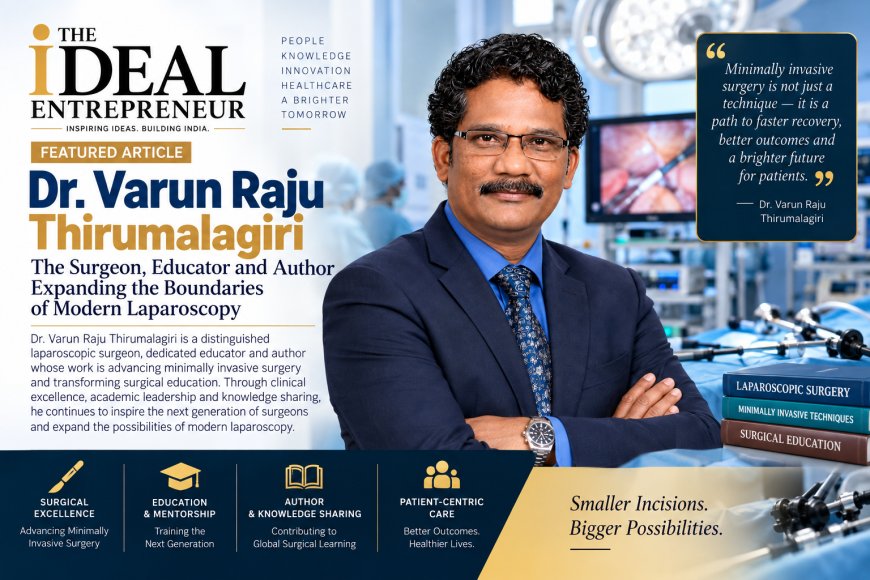
Dr. Varun Raju Thirumalagiri: The Surgeon, Educator and Author Expanding the Boundaries of Modern Laparoscopy
Based in Hyderabad, Telangana, Dr. Thirumalagiri is the founder of TVR Laparoscopy Center, an institution that has developed from a surgical clinic into a dedicated centre for laparoscopic surgery training. His professional journey reflects a distinctive combination of clinical practice and academic contribution—one in which treating patients is only one part of the responsibility of a surgeon.
 admin
From the operating room to surgical classrooms, textbooks and research, the Hyderabad-based laparoscopic and robotic surgeon has built a career around one enduring idea: advancing surgery by advancing the people who perform it.
Medicine has always evolved through the hands of people who refuse to accept that knowledge should remain confined to one operating room, one institution or one generation.
For Dr. Varun Raju Thirumalagiri, that philosophy has shaped a career spanning advanced laparoscopic and robotic surgery, postgraduate surgical education, research, medical illustration, textbook authorship and dedicated surgical training.
Based in Hyderabad, Telangana, Dr. Thirumalagiri is the founder of TVR Laparoscopy Center, an institution that has developed from a surgical clinic into a dedicated centre for laparoscopic surgery training. His professional journey reflects a distinctive combination of clinical practice and academic contribution—one in which treating patients is only one part of the responsibility of a surgeon.
The other part, in his view, is helping the next generation of surgeons become better prepared for the increasingly sophisticated demands of modern surgery.
That philosophy is visible throughout his career: in the surgeons he has trained, the books he has authored, the illustrations he has created for international surgical literature, the scientific work he has published, and the academic institutions in which he has taught.
From a Teachers' Family to a Life in Surgery
Dr. Varun Raju Thirumalagiri was born in Miryalaguda in Telangana's Nalgonda district, into a family of teachers.
Being the eighth son in a teachers' family meant that education was not simply an institutional experience—it was part of the environment in which he grew up.
That background would later become particularly significant.
Although surgery eventually became his primary professional identity, teaching would remain deeply embedded in his career. Decades later, he would not only perform advanced surgery but also teach postgraduate surgeons, contribute to surgical textbooks and establish a specialised training centre.
He pursued his MBBS at Kurnool Medical College, joining the 1988 batch.
Following his undergraduate education, he entered postgraduate DNB studies through the National Board of Examinations, New Delhi. His postgraduate training brought him into contact with senior surgical mentors, including professors associated with FRCS-level surgical training.
The environment demanded discipline, academic rigor and precision—qualities that became recurring themes in his professional life.
After completing his postgraduate training, he continued to develop his expertise through specialised fellowships and professional qualifications, including FIAGES, FMAS, and FALS, with advanced training interests encompassing hepatopancreatobiliary and hernia surgery.
Over time, his professional focus increasingly moved toward minimally invasive surgery and advanced laparoscopic procedures.
But the evolution did not stop at becoming a specialist surgeon.
He began building an ecosystem around surgical knowledge itself.
TVR Laparoscopy Center: From Surgical Clinic to Training Institution
In 2020, Dr. Thirumalagiri established TVR Laparoscopy Center in Madinaguda, Hyderabad.
What began as a surgery clinic gradually developed into a dedicated laparoscopic surgery training centre.
The transformation is important because it represents a larger shift in his professional philosophy.
A surgeon can perform hundreds or thousands of operations during a career. A surgical educator, however, has the opportunity to influence the careers of hundreds of other surgeons.
TVR Laparoscopy Center was developed with this broader objective.
The centre conducts a four-month fellowship-oriented hands-on laparoscopic surgery training programme associated with the national IMA (AMS) framework described by the institution. The programme is designed to provide surgeons with practical exposure and structured learning in laparoscopic surgery.
Over the years, hundreds of surgeons have undergone training through the programme and have gone on to practise in different parts of India.
For a surgeon who grew up in a family where teaching was central to everyday life, this evolution from clinician to educator appears almost natural.
The operating room became a classroom.
And the classroom became an extension of the operating room.
Teaching Beyond the Operating Theatre
Dr. Thirumalagiri's academic career extends well beyond his own institution.
He has worked as a Professor of Surgery in institutions offering DNB postgraduate surgical education in Hyderabad.
His involvement in postgraduate education has included responsibilities connected with the training and assessment of surgeons. He has served as an internal and external examiner for postgraduate General Surgery examinations.
These roles demand a different form of expertise from clinical practice.
A surgeon performing an operation must make decisions in real time.
A surgical teacher must explain why those decisions are made.
An examiner must evaluate whether another surgeon understands those principles sufficiently to apply them independently.
This combination has allowed Dr. Thirumalagiri to remain closely connected with both surgical practice and surgical education.
His academic engagement also extends beyond conventional medical education.
He has been involved as a PhD board member of the Biomedical Engineering College at Osmania University, Telangana, following his teaching contribution in General Surgery for engineering students dating back to 2003.
That intersection between surgery and engineering is particularly relevant in an era when medicine is increasingly shaped by robotics, medical devices, imaging technologies, artificial intelligence and biomedical innovation.
The modern surgeon is no longer working in isolation from technology.
The operating theatre itself has become a convergence point between medicine, engineering and advanced technology.
A Surgeon Who Writes
Another defining dimension of Dr. Thirumalagiri's career is his work as a medical author.
For many surgeons, the textbook is something they consult.
For Dr. Thirumalagiri, it has also become something he creates.
His published works include:
-
Timeline History of Laparoscopy and Hernia Surgery
-
SCOPY
-
Think Again
These books reflect his interest in documenting, explaining and communicating surgical knowledge.
His forthcoming work represents an even larger undertaking.
Textbook of Hernia and Abdominal Wall Reconstruction
A major reference work on Hernia and Abdominal Wall Reconstruction, running to approximately 2,000 pages, is planned for publication by Springer in the United States, with release planned for December 2026.
If released as planned, the book would represent another significant chapter in his long engagement with surgical education.
Hernia surgery has developed considerably over the decades, moving from conventional repair techniques toward increasingly sophisticated approaches involving minimally invasive surgery, abdominal wall reconstruction and complex decision-making.
A comprehensive reference work in such a field requires more than surgical experience.
It requires the ability to organise a large body of knowledge, interpret techniques, explain anatomy and communicate complex concepts clearly.
For a surgeon who has spent years teaching postgraduate students and training practising surgeons, authorship becomes a natural extension of education.
The book is not simply another publication.
It represents the idea that surgical knowledge should be systematically documented for the people who will use it tomorrow.
The Art Behind the Anatomy
Perhaps one of the most unusual aspects of Dr. Thirumalagiri's professional identity is his work as a medical illustrationist.
Within the surgical community, he is recognised for his work creating illustrations for surgical literature and has served as a chief illustrationist for chapters in international surgery books.
This is more significant than it might initially appear.
Surgery is fundamentally visual.
A surgeon must understand three-dimensional anatomy from two-dimensional images, interpret spatial relationships, anticipate what lies beneath tissue and translate anatomical knowledge into physical action.
A well-designed surgical illustration can therefore communicate something that paragraphs of text cannot.
It can show a plane of dissection.
A surgical landmark.
A reconstruction technique.
A critical anatomical relationship.
Or the difference between a safe and unsafe surgical approach.
Dr. Thirumalagiri's involvement in medical illustration brings together two disciplines that are rarely associated with the same individual: surgical practice and visual communication.
His illustrations become another form of teaching.
The scalpel explains anatomy through action.
The illustration explains anatomy through visual language.
The textbook preserves that knowledge for future generations.
Together, these three elements form a powerful educational cycle.
Research as a Continuous Process
Clinical expertise becomes stronger when it is questioned, tested and documented.
Dr. Thirumalagiri has contributed scientific papers to surgical forums at national and international levels, including work connected with abdominal wall reconstruction.
He has also published original surgical studies in indexed national and international journals and contributed chapters to surgery books associated with the National Annals of Surgery.
Research creates a different relationship with medicine.
A clinical experience may suggest that a technique works.
Research asks why.
It asks whether the outcome can be measured.
Whether it can be reproduced.
Whether another surgeon can achieve comparable results.
Whether a technique is genuinely better than an established alternative.
That culture of questioning is particularly important in advanced laparoscopic and robotic surgery, where technology continues to expand the possibilities available to surgeons.
The surgeon of tomorrow will increasingly need to combine technical ability with evidence-based decision-making.
Dr. Thirumalagiri's involvement in research, teaching and clinical practice places him within that changing landscape.
A Dedicated Focus on Hernia and Abdominal Wall Surgery
Hernia surgery occupies a particularly important position in Dr. Thirumalagiri's professional work.
His advanced fellowship interests include hernia surgery and abdominal wall reconstruction, and his forthcoming major textbook is specifically dedicated to this area.
Abdominal wall reconstruction is a field in which surgical planning can become highly complex.
The surgeon must consider anatomy, tissue quality, previous operations, defects, functional requirements and reconstruction strategies.
The objective is not merely to close a defect.
It is to restore the structural integrity and function of the abdominal wall while reducing complications and improving long-term outcomes.
This complexity makes specialised training particularly valuable.
It also explains why dedicated education, surgical illustration and comprehensive reference literature can play such an important role in the field.
Leadership Beyond Individual Practice
Dr. Thirumalagiri has also served as an executive committee member of the Hernia Society of India (HSI).
Professional associations play an important role in advancing specialised fields.
They create platforms where surgeons can exchange knowledge, discuss emerging techniques, present research and build professional standards.
For an individual surgeon, participation in such organisations extends professional responsibility beyond personal clinical practice.
It becomes a contribution to the larger surgical community.
His involvement with HSI is therefore consistent with the broader direction of his career: surgery not as an isolated profession, but as a constantly evolving community of practitioners, educators and researchers.
Recognition Across the Surgical Community
Over the course of his career, Dr. Thirumalagiri has received multiple recognitions.
Among the awards associated with his professional journey are:
-
Times of India – Best Surgeon Award
-
Meditech Award – Osmania University, Telangana
-
ASI National Presidential Award
-
ASI Telangana State Chapter Chairman's Appreciation Award
-
National Connect – Best Advanced Laparoscopic Surgeon Award
-
National Excellence Council – Telangana Awards 2026 – Best Robotic Surgery Award
These recognitions reflect different dimensions of his career—from surgical practice and academic contribution to advanced laparoscopic and robotic surgery.
Yet awards are only one measurement of professional influence.
The more enduring measure may be found in the surgeons trained under his programmes, the knowledge preserved in his books, the research entering the scientific literature and the educational resources created for the surgical community.
Beyond Medicine: The Musician Within the Surgeon
There is another side to Dr. Varun Raju Thirumalagiri that makes his story unusually multidimensional.
He is also a Carnatic classical musician.
His musical work includes a research-oriented project titled “Melakartha 72 Ambiences,” described as a world-record musical research product.
His musical work has also found a digital audience through his DR TVR Channel, which has reportedly accumulated approximately 1.18 crore views and 28.5 thousand subscribers.
At first glance, surgery and Carnatic music may appear to belong to completely different worlds.
One is governed by anatomy, physiology, precision and technology.
The other is governed by rhythm, melody, discipline and artistic expression.
But both demand concentration.
Both require years of practice.
Both reward attention to detail.
And both require the ability to understand structure.
In surgery, structure becomes anatomy.
In music, structure becomes rhythm and melody.
Perhaps this explains why the same individual can move between the precision of a surgical procedure and the discipline of classical music without seeing them as contradictory pursuits.
They are different expressions of the same commitment to mastery.
Books and Literary Contributions
Dr. Varun Raju Thirumalagiri's intellectual interests extend beyond surgery and medical education into science, philosophy and creative writing. His published works reflect his interest in examining how people perceive reality, knowledge and society from different perspectives.
1. SCOPY
SCOPY is a book exploring ideas across science, psychology and philosophy. One of its central concepts is that human perception can change depending on the distance and perspective from which an object is observed.
The book uses the contrast between scale and perception to explore this idea. A tiny grain of a salt crystal, when viewed through a microscope, can appear remarkably large and complex—almost like a mountain. At the same time, the enormous Sun, when viewed from Earth, appears relatively small because of the immense distance separating the observer from it.
Through this contrast, SCOPY explores how perception can influence the way people understand objects, situations and reality. The work encourages readers to consider how distance, perspective and the method of observation can alter one's understanding of what appears to be true or significant.
The book brings together scientific observation with psychological and philosophical thought, encouraging readers to look beyond immediate appearances and consider different dimensions of perception.
2. Think Again
Think Again is a novel built around a debate between scientists and common people, facilitated by a village head who brings different viewpoints together.
The narrative explores situations where traditional beliefs, social practices and scientifically established facts may appear to conflict with one another.
Rather than presenting the discussion as a simple contest between one side being completely right and the other completely wrong, the novel examines the importance of understanding different perspectives.
Through the village debate, the story encourages readers to consider how scientific reasoning, cultural traditions, beliefs and family values can coexist within society.
A central message of the novel is that differences in belief and interpretation should be approached with respect. The story explores the possibility of maintaining an Indian cultural system and family-oriented way of life while also recognising the importance of scientific facts and rational understanding.
Think Again therefore goes beyond a conventional debate between science and belief. It presents the idea that society can benefit from dialogue, mutual respect and thoughtful coexistence, allowing individuals and families to preserve meaningful cultural practices while remaining open to knowledge and changing perspectives.
The Evolution of a Modern Surgeon
The traditional image of a surgeon is often centred around the operating theatre.
But the modern surgical leader increasingly occupies several worlds simultaneously.
There is the clinician.
There is the educator.
There is the researcher.
There is the author.
There is the mentor.
There is the medical communicator.
And increasingly, there is the surgeon working alongside technology.
Dr. Thirumalagiri's career reflects this broader definition.
His journey began with medical education and postgraduate surgical training.
It expanded through advanced laparoscopic fellowships.
It moved into postgraduate teaching.
Then into dedicated hands-on surgical training.
Then into research and publication.
Then into medical illustration and textbook authorship.
And now into the expanding field of robotic surgery.
Each stage builds on the previous one.
The surgeon teaches what he knows.
The author documents what he has learned.
The researcher questions what is known.
The illustrator makes difficult concepts visible.
And the mentor prepares another generation to take the field forward.
Six Questions for Dr. Varun Raju Thirumalagiri
1. What inspired you to move from conventional surgical practice toward advanced laparoscopic and robotic surgery, and what changes have you witnessed in the field throughout your career?
2. TVR Laparoscopy Center has evolved from a surgical clinic into a dedicated training centre. What skills do you believe today's surgeons must develop beyond simply learning how to perform laparoscopic procedures?
3. You have combined surgery with textbook authorship and medical illustration. How does visual communication change the way complex surgical anatomy and techniques are understood?
4. Your forthcoming Textbook of Hernia and Abdominal Wall Reconstruction is planned as a major reference work. What gaps in existing surgical literature motivated you to undertake such an extensive project?
5. How do you see robotics, advanced imaging, biomedical engineering and other technologies changing the role of the surgeon over the next decade?
6. You have pursued both surgery and Carnatic classical music. How has music influenced your approach to discipline, concentration, creativity and professional life?
Building Knowledge That Outlives the Surgeon
There is a difference between having a successful surgical career and building a legacy in surgery.
A successful surgeon may be remembered by the patients treated.
A teacher may be remembered by the students trained.
An author may be remembered through books.
A researcher may be remembered through published work.
An illustrator may be remembered through images that continue to teach long after they were created.
Dr. Varun Raju Thirumalagiri's professional journey brings all of these dimensions together.
His work at TVR Laparoscopy Center represents the practical side of his mission: training surgeons through hands-on experience.
His academic career represents the educational side.
His research represents the scientific side.
His books represent the literary side.
His illustrations represent the visual side.
And his music represents the creative side.
Together, they create a professional identity that extends beyond the conventional boundaries of surgery.
The Ideal Entrepreneur Perspective
Entrepreneurship is not limited to building companies.
In medicine, entrepreneurship can mean identifying a gap in education and creating a training institution to address it.
It can mean transforming personal experience into a reference textbook.
It can mean developing educational illustrations that make complicated surgical concepts easier to understand.
It can mean investing decades in research and teaching rather than limiting one's contribution to clinical practice.
Dr. Varun Raju Thirumalagiri's journey demonstrates this broader meaning of professional entrepreneurship.
The creation of TVR Laparoscopy Center reflects an institutional approach to knowledge.
His books reflect intellectual entrepreneurship.
His medical illustrations represent creative entrepreneurship.
His research represents scientific entrepreneurship.
And his musical work demonstrates that professional excellence does not necessarily require abandoning other dimensions of creativity.
The most interesting part of his story may therefore not be a particular award, book or surgical technique.
It is the philosophy connecting them.
Learn. Practise. Question. Teach. Document. Create. Then pass the knowledge forward.
That is how a surgeon becomes more than a practitioner.
That is how professional expertise becomes an institution.
And that is how one career can begin influencing an entire generation of professionals.
Dr. Varun Raju Thirumalagiri
Founder, TVR Laparoscopy Center | Advanced Laparoscopic & Robotic Surgeon | Surgical Educator | Author | Medical Illustrationist
TVR Laparoscopy Center
302, Kalki Chambers, Madinaguda, Hyderabad, Telangana
Phone: 9866159160
Email: varnaraju1@gmail.com