I.V. Subba Rao’s Cristobalite Breakthrough: Redefining High-Purity Silica Production Through Flux-Free Kiln Technology
At Raghuvamsi Technologies, I.V. Subba Rao is advancing a flux-free rotary kiln approach to transform natural quartz into high-purity cristobalite—opening new possibilities for precision materials, ceramics, refractories and advanced industrial applications.
 admin
From Natural Quartz to High-Value Cristobalite: How I.V. Subba Rao and Raghuvamsi Technologies Are Exploring a Flux-Free Route to Advanced Silica Materials
A continuous rotary-and-tunnel-kiln approach from Andhra Pradesh aims to transform quartz into high-crystallinity cristobalite without conventional chemical fluxes, opening possibilities across ceramics, refractories, dental materials, coatings and advanced industrial applications
By The Ideal Entrepreneur
In the world of industrial materials, some of the most important innovations are not always visible to consumers.
They do not arrive as a new smartphone, an electric vehicle or a consumer-facing technology platform.
Instead, they emerge inside furnaces, kilns, laboratories and manufacturing processes—where the transformation of an ordinary mineral into a high-value engineered material can influence entire industries.
One such area of research is the transformation of natural quartz into cristobalite, a high-temperature polymorph of silica with applications across ceramics, refractories, coatings, glass, dental materials and other specialised industries.
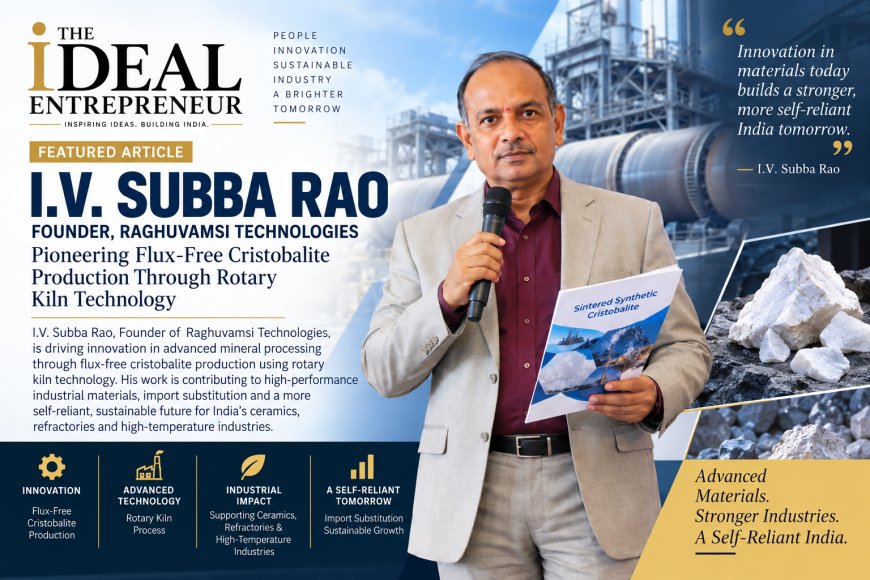
At the centre of a technology development effort in Andhra Pradesh is I.V. Subba Rao of Raghuvamsi Technologies, whose supplied technical study describes an innovative approach for producing synthetic cristobalite through a continuous, flux-free rotary kiln and tunnel kiln process.
The proposed technology focuses on a simple but technically demanding objective:
Can natural quartz be transformed into high-purity cristobalite through controlled thermal processing without relying on alkali fluxes, mineralizers or other chemical additives?
According to the study supplied to The Ideal Entrepreneur, the answer demonstrated by the reported experimental work is promising.
The study reports a predominantly crystalline product containing approximately 90% α-cristobalite and 10% residual low quartz, with no significant detectable amorphous or glassy phase in the reported XRD analysis.
More broadly, the research presents a potential industrial route for continuous cristobalite production based on carefully controlled temperature, residence time and thermal gradients.
If developed and scaled successfully, such a process could offer an alternative approach to manufacturing value-added silica materials.
The Technology Behind the Story
Cristobalite is a crystalline form of silicon dioxide (SiO₂).
Silica occurs naturally in several structural forms, with quartz being among the most familiar. Under suitable high-temperature conditions, silica can undergo structural rearrangement and form different polymorphs.
Cristobalite is particularly relevant to high-temperature industrial applications because of its thermal, mechanical and structural characteristics.
The challenge is not simply to heat quartz.
Industrial production requires control over several variables at the same time:
- Temperature
- Heating rate
- Residence time
- Particle size
- Heat transfer
- Thermal gradients
- Phase transformation
- Cooling conditions
- Product uniformity
Traditional approaches can involve static sintering of finely ground quartz for extended periods.
The Raghuvamsi Technologies study instead focuses on a continuous rotary-kiln-based process, combined with a tunnel-kiln concept, to create a controlled thermal environment for the transformation.
The Core Innovation: A Flux-Free Approach
The most distinctive feature of the reported process is its flux-free character.
In many mineral and ceramic processes, chemical additives or mineralizers can be used to influence transformation temperatures and reaction behaviour.
The technology described by Raghuvamsi Technologies takes a different route.
The supplied study states that the process does not use:
- Alkali fluxes
- Chemical catalysts
- Mineralizers
- Other external fluxing agents
Instead, the transformation is driven primarily through thermal control and feedstock characteristics.
This means that the process seeks to use the physical conditions inside the kiln—rather than chemical additives—to encourage quartz-to-cristobalite transformation.
That distinction is important from both a scientific and industrial perspective.
A successful additive-free process could potentially simplify the material system, reduce concerns associated with unwanted chemical additions and provide greater control over the final silica composition.
Why the Rotary Kiln Matters
A rotary kiln is fundamentally different from a static furnace.
Inside a rotary kiln, material moves continuously through controlled thermal zones.
The study describes a process involving different stages, including:
Preheating → Reaction → Sintering
As the feed moves through the kiln, it is exposed to progressively controlled thermal conditions.
This continuous movement can provide opportunities to control:
- Residence time
- Heat exposure
- Thermal gradients
- Material mixing
- Reaction conditions
- Product consistency
The objective is to create conditions where quartz particles can undergo the required structural transformation while minimising unwanted phases.
The technology therefore places considerable emphasis on thermal regime and residence-time control.
From Quartz to Cristobalite
At the heart of the process is a mineralogical transformation.
The supplied study describes the transformation pathway as:
Quartz → High-Quartz → Cristobalite
The research emphasises controlling the reaction so that the process can promote cristobalite formation while avoiding significant intermediate tridymite formation.
That is one of the technical challenges in silica phase transformation.
The desired outcome is a controlled transformation that produces a predominantly cristobalite-containing material with consistent properties.
According to the supplied study, the process relies on:
- Controlled high-temperature treatment
- Optimised residence time
- Thermal gradients
- Surface nucleation
- Internal restructuring
- Feedstock morphology
The study describes this as a kinetically controlled route intended to promote direct transformation toward cristobalite.
The High-Temperature Challenge
The study reports sintering conditions in the range of approximately 1700°C–1750°C for one of the characterised samples.
At such temperatures, thermal control becomes critical.
The challenge is not merely reaching a high temperature.
The material must experience the appropriate thermal history.
Too little heat exposure can leave unconverted quartz.
Poor heat transfer can create differences between particle surfaces and internal regions.
An uncontrolled thermal profile can influence phase composition and morphology.
The reported rotary-kiln approach attempts to address these challenges by controlling the movement and thermal exposure of the material.
What the XRD Results Report
The most important evidence presented in the supplied study comes from X-ray diffraction (XRD).
XRD is used to identify crystalline phases by analysing characteristic diffraction patterns.
According to the detailed XRD interpretation supplied by Raghuvamsi Technologies, the analysed material contained approximately:
90% α-cristobalite
and
10% low quartz
The report identifies the cristobalite phase using reference code 98-006-1813 and the quartz phase using reference code 98-004-0799.
The study states that no significant amorphous or glassy phase was detected.
This is important because it indicates that the reported product is predominantly crystalline rather than containing a substantial glassy fraction.
What the 90% Cristobalite Result Means
The reported approximately 90% α-cristobalite content indicates a substantial quartz-to-cristobalite transformation in the tested material.
However, the presence of approximately 10% residual low quartz is equally important.
It means the transformation was substantial but, for this sample, not complete.
The study itself suggests that residual quartz may be associated with incomplete conversion in dense particle cores or limitations related to heat transfer and reaction kinetics.
That observation provides an important direction for further optimisation.
Industrial process development rarely ends with a single test.
Instead, each result provides information about what must be improved.
The residual quartz therefore becomes part of the next engineering question:
How can the process push conversion still further while maintaining product quality and economic viability?
No Significant Amorphous Phase Reported
Another notable observation in the supplied XRD interpretation is the absence of a distinct broad amorphous hump.
The report therefore considers the amorphous or glass-phase content to be negligible or below the practical detection limit of the analysis.
This is potentially significant for applications where predictable crystalline behaviour is important.
A predominantly crystalline material can provide greater control over properties related to phase composition and thermal behaviour.
Understanding α-Cristobalite
The study specifically identifies α-cristobalite, described as the low-temperature form.
Cristobalite undergoes a reversible structural transition between its high- and low-temperature forms.
The supplied report places the α–β transition approximately in the 200–270°C range, depending on measurement conditions and composition.
During cooling, the high-temperature form can transform into the low-temperature α form.
The reported XRD result identifies α-cristobalite as the final predominant cristobalite phase, with no detectable β-cristobalite reported in the analysed material.
This phase behaviour is important because thermal cycling can influence the performance of cristobalite-containing materials.
The Microstructural Picture
The study also describes morphological and microstructural observations.
According to the supplied report, SEM examination showed a dense, fine-grained microstructure, with improved homogeneity and particle bonding.
Microstructure matters because the way particles are arranged and bonded can influence the performance of the final material.
For industrial applications, chemical composition alone is not enough.
Manufacturers also care about:
- Particle morphology
- Grain structure
- Homogeneity
- Density
- Thermal response
- Mechanical behaviour
- Consistency from batch to batch
The reported microstructural characteristics therefore complement the XRD findings.
Brightness and Chemical Purity
Another reported advantage concerns impurity levels.
The study identifies Fe₂O₃, Al₂O₃ and TiO₂ as impurities of interest and states that the final sintered products showed reduced levels of these components.
This has particular relevance for applications where whiteness and brightness are important.
High brightness can be valuable in areas such as:
- Ceramics
- Paints
- Coatings
- Specialty silica products
- Certain optical and decorative applications
The study consequently links the flux-free process with potential improvements in chemical purity and visual characteristics.
Why Avoiding Tridymite Matters
One of the technical objectives highlighted by the study is the avoidance of significant tridymite formation.
Silica can exist in several polymorphic forms, and controlling which phase forms is important when a specific product composition is required.
The Raghuvamsi Technologies approach aims to promote cristobalite formation through controlled kinetics and thermal processing.
The supplied research describes this as an effort to bypass significant tridymite formation.
This is one of the reasons the process depends so heavily on temperature profile, residence time and thermal control.
From Laboratory Concept to Industrial Process
The significance of the technology lies not only in the phase transformation itself.
The larger question is scalability.
A laboratory furnace can produce a material under carefully controlled conditions.
An industrial plant has to operate continuously.
It must handle:
- Feedstock variation
- Throughput
- Energy consumption
- Temperature control
- Residence time
- Material movement
- Equipment durability
- Product consistency
- Maintenance
- Economics
This is where the rotary kiln concept becomes particularly important.
A continuous kiln process potentially creates a pathway from experimental chemistry toward industrial production.
The supplied study presents the technology specifically as a scalable, continuous route for cristobalite production.
Why Continuous Processing Could Change the Equation
Continuous production can offer several potential advantages compared with batch or static processes.
Material can enter the system continuously.
Thermal exposure can be controlled along different zones.
Production can potentially be integrated into an industrial flow.
Residence time can be engineered around the desired transformation.
And the process can potentially be designed for larger production volumes.
The key word is potentially.
Actual industrial performance would depend on engineering validation, energy consumption, throughput, equipment design, raw-material consistency and economic analysis.
The supplied study establishes the technical concept and reported experimental results; further scale-up data would be needed to evaluate commercial performance fully.
The Industrial Applications Could Be Broad
Cristobalite is already associated with several industrial applications because of its silica chemistry and thermal characteristics.
The Raghuvamsi Technologies study identifies a broad potential application landscape.
These include:
Dental Ceramics
Cristobalite can be relevant to dental ceramic systems where controlled thermal expansion and dimensional stability are important.
The study highlights its potential use in dental materials.
Paints and Coatings
Its whiteness and potential matting characteristics make cristobalite relevant as a filler in certain paint and coating formulations.
Refractories
High-temperature stability makes cristobalite relevant to refractory and ceramic applications.
Advanced Ceramics
Controlled silica phases can be important in specialised ceramic formulations.
Foundry and Investment Casting
The study identifies foundry and investment casting among potential application areas.
Thermal-Insulation Materials
Its thermal characteristics can support specialised insulation-related applications.
Glass and Specialty Silica
Cristobalite can form part of broader silica-based material systems.
Semiconductor and Electronic Materials
The study identifies potential applications in semiconductor glass and composite materials.
Photovoltaic and Solar Applications
Specialty silica materials can have roles in high-temperature and manufacturing environments associated with solar technologies.
Aerospace and High-Temperature Technologies
The study also identifies aerospace and other high-temperature technologies as potential future application areas.
These applications represent potential markets identified in the supplied study, not claims that the reported material has already been commercially qualified for each application.
A Technology With Potential Environmental Advantages
The flux-free nature of the process is also significant from an environmental and process-simplicity perspective.
The study describes the technology as avoiding alkalis and other chemical additives.
This could potentially simplify the raw-material chemistry and reduce the need to manage additional chemical inputs.
However, industrial environmental performance cannot be judged only by whether fluxes are absent.
A complete assessment would also need to consider:
- Kiln energy consumption
- Fuel or electricity source
- Emissions
- Heat recovery
- Throughput
- Waste generation
- Raw-material processing
- Overall lifecycle impact
The study positions the process as environmentally cleaner due to its flux-free character, while broader lifecycle assessment would be required for a full environmental comparison.
The Bigger Opportunity: Value Addition to Quartz
At a commercial level, perhaps the most interesting aspect of the technology is the idea of value addition.
Natural quartz is widely available in many regions.
But converting a mineral feedstock into a specialised, high-value engineered silica product can create significantly different economic opportunities.
Instead of selling only a raw mineral, producers can potentially participate in a higher-value materials segment.
This is the industrial logic behind the research:
natural quartz → controlled thermal transformation → synthetic cristobalite → specialised industrial applications
The technology therefore sits at the intersection of mineral processing, ceramics, thermal engineering and advanced materials.
Raghuvamsi Technologies: A Materials Technology Story
The supplied research identifies Raghuvamsi Technologies, Andhra Pradesh, India as the organisation associated with the work.
At the centre of the project is I.V. Subba Rao, whose contact details are provided with the technical study.
The research represents an effort to address a specific industrial materials challenge through process innovation rather than chemical modification.
That distinction gives the work its identity.
Instead of adding more chemistry to the process, the approach seeks to gain greater control through thermal engineering.
The Engineering Philosophy Behind the Process
The technology can be understood through one central principle:
Control the heat, and control the transformation.
The proposed system uses a combination of thermal zones, controlled residence time and material movement.
The feedstock enters the process.
It experiences preheating.
It moves through reaction conditions.
It reaches high-temperature sintering conditions.
The material then cools and emerges with a different phase composition.
The transformation is therefore engineered rather than simply left to occur under uncontrolled heating.
Why Residence Time Matters
Temperature alone cannot explain a solid-state transformation.
The material must remain under appropriate conditions for sufficient time.
Too short a residence time can leave unconverted quartz.
Too long a residence time may increase energy consumption without delivering proportional benefits.
The right residence time must therefore balance:
conversion + product quality + energy + throughput.
This is one of the reasons continuous kiln engineering becomes central to the technology.
The Role of Particle Size
The supplied study indicates that feedstock grain sizes in the range of approximately 3 mm to 30 mm can be suitable for rotary processing.
Particle size can influence heat transfer and reaction kinetics.
Larger particles may develop internal temperature differences during heating.
Smaller particles can respond more rapidly to thermal conditions.
The process therefore has to consider the relationship between feed size, residence time and heat penetration.
This also helps explain why the study attributes some residual quartz to incomplete conversion within dense particle cores.
A Process Designed Around Thermal Control
The technology can therefore be viewed as a coordinated system rather than a single piece of equipment.
The feedstock.
The particle size.
The kiln design.
The thermal zones.
The residence time.
The sintering temperature.
The cooling cycle.
The phase transformation.
Each influences the final product.
That systems-level approach is what gives the research potential industrial significance.
What the Reported Results Tell Us
The supplied results can be summarised as follows:
Predominant phase: α-cristobalite
Reported content: approximately 90%
Residual phase: approximately 10% low quartz
Amorphous/glassy phase: not detected or negligible by the reported XRD interpretation
β-cristobalite: not detected
Reported sintering range for characterised sample: approximately 1700°C–1750°C
Process: flux-free rotary-kiln-based thermal processing
Additives: no alkali fluxes or external mineralizers reported
These results support the study's central claim that substantial cristobalite formation can be achieved through controlled thermal processing without conventional flux addition.
The 10% Quartz Is Also a Research Opportunity
A strong technology story should not hide the remaining challenge.
The reported 10% residual quartz matters.
It shows that the process achieved a high degree of transformation but not complete conversion in the analysed sample.
That opens an important area for future optimisation.
Possible process variables to investigate could include:
- Higher or more uniform heat penetration
- Residence-time optimisation
- Feedstock preparation
- Particle-size optimisation
- Kiln-zone configuration
- Thermal-gradient management
- Improved material movement
These are engineering questions for further development.
The study itself identifies incomplete transformation within dense particle cores as one possible explanation.
Why This Research Matters to Indian Manufacturing
India has significant mineral resources and a large industrial base spanning ceramics, glass, refractories, foundry, construction materials and specialty manufacturing.
Technologies that can convert naturally available minerals into higher-value industrial products have potential strategic importance.
The opportunity is not simply to produce another silica material.
It is to develop process know-how that can potentially be adapted for continuous industrial production.
If successfully scaled, such technologies can contribute to domestic manufacturing capabilities in advanced materials.
The Road From Research to Commercialisation
The transition from a technical study to an industrial product requires several additional stages.
These could include:
- Repeated pilot-scale trials
- Larger-volume production testing
- Energy-consumption measurement
- Process optimisation
- Product consistency testing
- Detailed chemical analysis
- Application-specific qualification
- Long-duration kiln trials
- Economic modelling
- Customer and industry validation
The supplied research establishes a technical foundation.
The next stage is demonstrating that the process can maintain its reported performance consistently at larger scale.
A Potential Platform Technology
One of the interesting aspects of the approach is that it is not necessarily limited to one specific quartz feedstock.
The study states that the technology is suitable for crystalline or amorphous silica inputs, subject to appropriate processing conditions.
That creates the possibility of treating the process as a broader silica-transformation platform.
The central principle remains controlled thermal transformation.
The exact process parameters would need to be adjusted according to feedstock characteristics and desired product specifications.
The Vision Behind the Technology
At its heart, the Raghuvamsi Technologies project represents a materials-science vision:
Take a naturally occurring mineral.
Understand its transformation behaviour.
Control the thermal environment.
Avoid unnecessary chemical additions.
Produce a higher-value engineered material.
This is the kind of industrial innovation that can have significance beyond a single product.
It represents a broader approach to manufacturing based on process control and material science.
6 Questions for I.V. Subba Rao
1. What problem in conventional cristobalite production motivated you to develop the rotary-kiln and tunnel-kiln approach?
The Ideal Entrepreneur:
Traditional production methods can require high temperatures and long processing periods. What limitations did you observe in conventional methods, and when did you realise that thermal control through a continuous kiln could offer a different route?
2. What is the biggest technological difference between your flux-free process and conventional cristobalite manufacturing?
The Ideal Entrepreneur:
Your study emphasises that the process does not depend on alkali fluxes, mineralizers or chemical catalysts. How does removing these additives change the process, product chemistry and overall manufacturing philosophy?
3. Your XRD results report approximately 90% α-cristobalite and 10% residual quartz. What are the next technical targets?
The Ideal Entrepreneur:
The reported result demonstrates substantial transformation, but residual quartz remains. What process improvements are you currently considering to increase conversion further while maintaining energy efficiency and product consistency?
4. Which industries do you believe could benefit most from this technology?
The Ideal Entrepreneur:
The study identifies applications ranging from dental ceramics and refractories to paints, coatings, glass, electronics, photovoltaics and high-temperature technologies. Which applications do you believe offer the strongest immediate commercial opportunity?
5. What challenges must be solved before this technology can move from technical development to large-scale industrial production?
The Ideal Entrepreneur:
What are the biggest remaining challenges—kiln design, energy consumption, feedstock consistency, residence time, product qualification, economics or something else?
6. What is your long-term vision for Raghuvamsi Technologies and this cristobalite technology?
The Ideal Entrepreneur:
Do you see this primarily as a cristobalite production technology, or could the underlying continuous thermal-processing approach eventually become a broader platform for producing advanced silica and mineral-based materials in India?
What Makes the Raghuvamsi Approach Different?
The supplied research highlights several characteristics that distinguish the proposed process:
Flux-Free
The process is designed without alkali fluxes, mineralizers or other external chemical additives.
Continuous
The rotary-kiln concept is designed around continuous material movement rather than only static batch processing.
Thermally Controlled
The transformation relies on controlled temperature zones, thermal gradients and residence time.
Predominantly Crystalline
The reported XRD analysis identifies approximately 90% α-cristobalite and 10% low quartz, with no significant detectable amorphous phase.
Scalable in Concept
The process is presented as suitable for industrial-scale continuous production, subject to further engineering and commercial validation.
Broad Application Potential
The study identifies applications across ceramics, refractories, dental materials, coatings, glass, foundry, electronics, solar, aerospace and other high-temperature technologies.
The Larger Industrial Story
The story of Raghuvamsi Technologies is ultimately not only about cristobalite.
It is about the search for a better way to transform materials.
Industrial progress often comes from making an existing process:
cleaner,
simpler,
more continuous,
more controllable,
more scalable,
or
more valuable.
The proposed flux-free rotary-kiln route attempts to address several of these objectives simultaneously.
The technology seeks to transform quartz into a high-value crystalline silica product through controlled thermal processing, while avoiding conventional flux additions.
The reported results provide an encouraging technical foundation.
The remaining challenge is scale.
From Mineral to Advanced Material
The difference between a raw mineral and an advanced industrial material is often the process applied to it.
Quartz exists naturally.
Cristobalite can be produced through controlled transformation.
The value lies in controlling that transformation sufficiently well that the resulting material meets the requirements of demanding industrial applications.
That is where the work of Raghuvamsi Technologies becomes particularly interesting.
It places process engineering at the centre of materials innovation.
The Ideal Entrepreneur Perspective
Innovation does not always begin with a completely new material.
Sometimes it begins with an old material and a new way of processing it.
That is the story emerging from the cristobalite research associated with I.V. Subba Rao and Raghuvamsi Technologies.
The supplied study proposes a continuous, flux-free thermal route for converting natural quartz into synthetic cristobalite.
Its reported XRD findings show approximately 90% α-cristobalite and 10% residual low quartz, with no significant detectable amorphous phase.
The research also describes a fine-grained microstructure, controlled thermal transformation and reduced levels of selected impurities such as Fe₂O₃, Al₂O₃ and TiO₂.
But perhaps the most important idea is the process philosophy.
Rather than depending on chemical fluxes to drive transformation, the technology seeks to use thermal engineering, residence time and controlled kiln conditions.
That is a distinctly industrial approach.
The opportunity ahead is to prove whether the laboratory and technical results can be translated into reliable, cost-effective and consistent large-scale production.
If that transition is successfully achieved, the technology could potentially contribute to India's growing advanced-materials ecosystem.
For an industry increasingly interested in high-value manufacturing, domestic process innovation and materials engineering, the work represents an important question worth watching:
Can better control of heat turn an abundant mineral into a higher-value industrial material—without relying on conventional chemical fluxes?
Raghuvamsi Technologies is attempting to answer that question through its work on flux-free synthetic cristobalite.
And behind that effort is a broader entrepreneurial idea:
Innovation is not always about inventing something that never existed. Sometimes, it is about discovering a better way to transform what already exists.
I.V.S. Rao – From Iron Ore Pelletization to Advanced Mineral-Based Materials
The technological journey of I.V.S. Rao, based in Andhra Pradesh and Bengaluru, extends across mineral processing, process technology and the development of advanced mineral-based materials.
With extensive experience in mineral processing and industrial process development, Rao has focused his work on creating technologies that can transform naturally available mineral resources into value-added industrial materials through innovative processing methods.
His technology development journey includes a patented process for Single-Stroke Iron Ore DRI Pelletization, followed by his recent work on the production of Sintered Synthetic Cristobalite from Quartz.
Together, these technologies demonstrate a continuing focus on one central engineering challenge:
How can conventional mineral-processing systems be redesigned to achieve more efficient, controlled and commercially valuable material transformation?
The Single-Stroke Iron Ore DRI Pelletization Technology
One of the significant milestones in I.V.S. Rao's technology development journey is his innovation in Single-Stroke Iron Ore DRI Pelletization.
The technology focuses on an innovative approach to the pelletization of iron ore for producing feed material suitable for Direct Reduced Iron (DRI) production.
The technology was filed in July 2008 under:
Patent Application No.: 1646/CHE/2008
and subsequently granted as:
Patent No.: 305155
with the patent being granted in 2019.
The development represents Rao's longstanding engagement with mineral-processing technology and his interest in improving conventional industrial processes through alternative process design.
DRI production requires suitable iron-bearing feed material with characteristics that enable efficient reduction during downstream processing.
Pelletization therefore plays an important role in preparing iron ore for use in DRI systems.
Rao's Single-Stroke approach represents an attempt to rethink the conventional pelletization process and develop an innovative process route for producing DRI feed material.
This earlier patented technology forms an important part of his broader technology portfolio.
It also provides context for understanding his subsequent work in advanced mineral-based materials.
From Iron Ore to Synthetic Cristobalite
The next stage of I.V.S. Rao's innovation journey moves from iron-bearing minerals to one of the world's most important industrial minerals: silica.
Rao has recently developed an innovative process technology for the production of Sintered Synthetic Cristobalite from Quartz.
The technology is based on the controlled transformation of quartz into cristobalite through a carefully designed thermal-processing route.
The development represents a significant shift in application while retaining the same underlying philosophy of process innovation: taking an existing mineral resource and developing a controlled industrial process capable of converting it into a higher-value material.
The technology was patented in August 2026.
At the heart of the innovation is the controlled Quartz-to-Cristobalite conversion process.
Rather than treating quartz simply as a conventional silica raw material, the process seeks to transform its crystalline structure into synthetic cristobalite through controlled thermal processing.
This creates the possibility of producing a specialised silica material for industries requiring specific thermal, structural and material characteristics.
Sintered Synthetic Cristobalite – A New Chapter in Mineral Processing
Cristobalite is a high-temperature polymorph of silica with applications across several advanced industrial sectors.
The challenge lies in producing synthetic cristobalite with controlled phase composition, high crystallinity, suitable purity and consistent characteristics.
I.V.S. Rao's technology approaches this challenge through controlled thermal processing of quartz.
The process is designed around the principles of:
Quartz selection → controlled thermal treatment → phase transformation → sintering → synthetic cristobalite
The technology is particularly significant because it is being developed for high-value application areas where material quality and consistency can be critical.
The innovation therefore extends beyond simple mineral conversion.
It represents an attempt to create an engineered mineral product designed for technologically demanding industries.
Technology for a Changing Industrial Landscape
The potential importance of high-purity synthetic cristobalite becomes clearer when viewed against the changing requirements of modern industry.
Today's advanced manufacturing sectors increasingly require materials with controlled:
-
Chemical composition
-
Crystal structure
-
Thermal behaviour
-
Purity
-
Particle characteristics
-
Mechanical properties
-
Dimensional stability
Silica-based materials already play important roles across multiple industries.
However, as technologies such as electric vehicles, renewable energy, semiconductor manufacturing and aerospace continue to develop, demand for specialised and high-performance materials is also expanding.
This creates potential opportunities for engineered mineral products such as high-purity synthetic cristobalite.
Key Application Areas for High-Purity Cristobalite
The technology developed by I.V.S. Rao is intended to address a range of industrial applications where high-purity cristobalite may offer technological value.
Advanced and Technical Refractory Raw Materials
High-temperature industries require refractory materials capable of performing under severe thermal conditions.
Synthetic cristobalite can serve as a specialised raw material in selected refractory formulations where controlled silica phases and thermal characteristics are important.
The availability of a controlled synthetic source could provide opportunities for manufacturers seeking greater consistency in their refractory formulations.
Specialty and Industrial Glass
Silica is fundamental to glass manufacturing.
Specialty glass applications can demand specific thermal, chemical and structural characteristics from their raw materials.
High-purity synthetic cristobalite therefore represents a potential value-added silica source for selected specialty and industrial glass applications, subject to application-specific qualification.
Paints and Chemicals
Cristobalite can have applications as a mineral component in selected paints, coatings and chemical formulations.
Its whiteness, hardness and thermal characteristics can be relevant to specialised formulations where controlled mineral properties are required.
The ability to manufacture synthetic cristobalite with controlled characteristics could therefore create opportunities in this sector.
Electric Vehicle Technologies
The rapid growth of electric mobility is driving demand for advanced materials across multiple components and manufacturing processes.
Materials used in thermal management, electrical insulation, ceramics, specialty glass and other high-temperature applications are becoming increasingly important.
High-purity silica-based materials such as synthetic cristobalite could potentially contribute to selected EV-related material systems where their properties meet the required specifications.
The relevance of the material will ultimately depend on the specific EV application and technical qualification requirements.
Solar and Renewable Energy Systems
The global transition toward renewable energy is creating demand for increasingly sophisticated materials.
Solar technologies, in particular, depend on a wide range of glass, ceramic, silica and other advanced materials.
High-purity synthetic cristobalite could potentially find applications in selected solar and renewable-energy material systems where controlled silica characteristics are required.
Semiconductor and Electronic Materials
Semiconductor and electronics manufacturing represents one of the world's most demanding material environments.
High-purity materials are essential because even very small levels of unwanted impurities can affect sensitive manufacturing processes.
Synthetic cristobalite could have potential relevance in selected electronic, ceramic, glass and silica-based material systems.
Such applications would require rigorous purity and contamination testing against the specifications of individual semiconductor and electronic processes.
Aerospace and Aeronautical Applications
Aerospace manufacturing places exceptional demands on materials.
High-temperature resistance, dimensional stability, thermal behaviour and material consistency can all become critical depending on the application.
Advanced silica-based materials may therefore have potential roles in selected aerospace, aeronautical, ceramic and thermal-management technologies.
Again, application-specific qualification would be essential before use in safety-critical aerospace systems.
Connecting Two Generations of Process Innovation
The significance of I.V.S. Rao's technology portfolio lies in the progression from one mineral-processing challenge to another.
His earlier patented work focused on iron ore pelletization for DRI feed production.
His newer innovation focuses on controlled quartz-to-cristobalite transformation.
The minerals are different.
The applications are different.
But the underlying approach remains consistent:
Understand the mineral. Understand the process. Redesign the transformation. Create a higher-value industrial product.
This philosophy is at the centre of Rao's work in process technology.
It reflects a belief that mineral resources should not be viewed only as commodities.
Through appropriate technology, they can become the starting point for advanced materials with applications across increasingly sophisticated industries.
From Mineral Resources to Advanced Materials
The future of mineral processing is increasingly connected with value addition.
Instead of exporting or consuming minerals primarily in their raw form, technological development can create opportunities to process them into specialised materials with higher functionality and greater industrial value.
I.V.S. Rao's work follows this direction.
The Single-Stroke DRI Pelletization technology represents value addition in the iron and steel ecosystem.
The Sintered Synthetic Cristobalite technology represents value addition in the silica and advanced-materials ecosystem.
Together, they illustrate how process technology can become a bridge between natural mineral resources and high-performance industrial materials.
An Innovation Journey That Continues
For I.V.S. Rao, the patent granted for Single-Stroke Iron Ore DRI Pelletization in 2019 was not the end of the technology journey.
It became part of a continuing process of experimentation, engineering and innovation.
The August 2026 patent for Sintered Synthetic Cristobalite marks another milestone in that journey.
The new technology moves into an area where material science, mineralogy and high-temperature process engineering intersect.
Its potential application landscape—from technical refractories and specialty glass to emerging areas associated with electric mobility, renewable energy, electronics and aerospace—reflects the increasingly interdisciplinary nature of advanced materials.
The broader vision is therefore not simply to manufacture cristobalite.
It is to develop a controlled technology platform for producing a value-added mineral material capable of serving the evolving requirements of modern industry.
And that vision continues a professional journey that began with mineral processing and has steadily moved toward increasingly specialised forms of material engineering.
From iron ore to silica.
From pelletization to polymorph transformation.
From conventional mineral processing to advanced mineral-based materials.
For I.V.S. Rao, innovation remains a continuous process—and the development of Sintered Synthetic Cristobalite represents the latest chapter in that journey.
About I.V. Subba Rao
I.V. Subba Rao is associated with Raghuvamsi Technologies, Andhra Pradesh, India, and is identified in the supplied technical study as the principal contact for the cristobalite technology.
The work focuses on the development of a flux-free, rotary-kiln-based process for synthetic cristobalite production from natural quartz and silica feedstocks.
Contact Details Provided
I.V. Subba Rao
Mobile: +91 7569160194
Email: ivsrao2003@yahoo.co.in
Additional Emails:
raatechs12@yahoo.com
raatech12@rediffmail.com
Organisation: Raghuvamsi Technologies
Location: Andhra Pradesh, India
Editorial Note
The technical findings, XRD percentages, process descriptions, application areas, record/reference codes and performance claims in this feature are based on the technical material supplied to The Ideal Entrepreneur by Raghuvamsi Technologies. They have been presented as reported findings of the supplied study and have not been independently laboratory-verified by The Ideal Entrepreneur. Commercial application, scale-up performance and application-specific qualification would require independent technical validation.