Pawan Verma: Fine Artist from Jhansi Creating Powerful Visual Stories | The Ideal Entrepreneur
Discover Pawan Verma, a young fine artist from Jhansi known for 700+ artworks and a 70-artwork Rani Laxmibai series celebrating history, culture and contemporary India.
 admin
admin
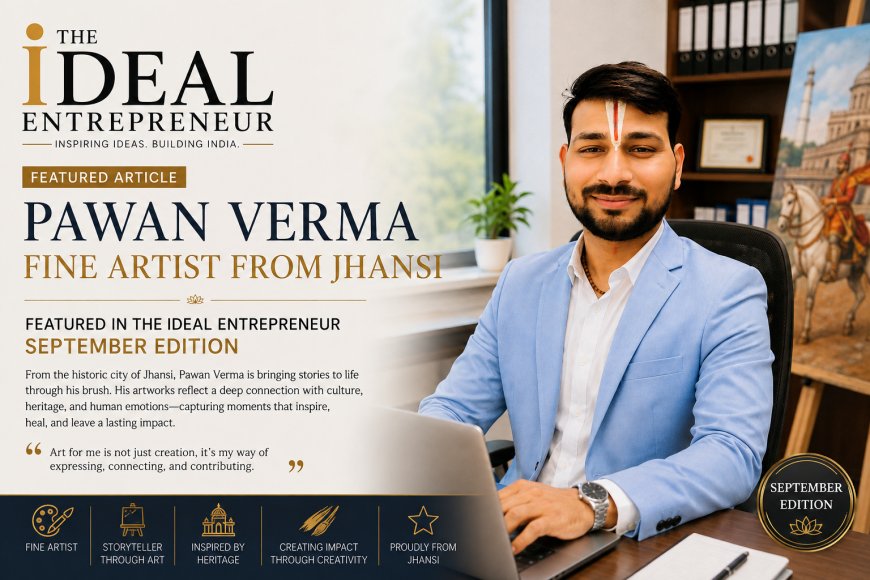
Pawan Verma: The Young Fine Artist Turning History, Heritage and Contemporary India Into Visual Stories
Fine Artist • Visual Storyteller • Historical & Cultural Artist
Art has the ability to preserve memories that words sometimes struggle to capture.
A painting can bring history closer.
A sketch can preserve an emotion.
A visual story can introduce an entire generation to a person or event they may never have experienced themselves.
For Pawan Verma, a young fine artist from Jhansi, Uttar Pradesh, art has gradually become a way of connecting history, culture, heritage and contemporary India.
According to the profile information supplied for this feature, Pawan began developing his artistic practice at a young age and has spent more than 12 years exploring art, creating a body of work of 700+ artworks.
His artistic interests include fine art, modern art, oil-based art, sketching, Madhubani art, Mandala art and Chittri Kala. His subjects range from India's historical heritage and national events to environmental awareness and contemporary social themes.
Among the most distinctive chapters of his journey is his 70-artwork series depicting the life journey of Rani Laxmibai of Jhansi.
For The Ideal Entrepreneur, Pawan's story is not simply about the number of artworks he has created. It is about how a young artist is using creativity to preserve stories, explore identity and develop his own artistic voice.
A Childhood That Became a Creative Journey
Pawan's relationship with art began early.
What initially started as an interest gradually became a serious artistic pursuit. Over the years, experimentation gave way to discipline, learning and a deeper understanding of visual storytelling.
For Pawan, art eventually became more than drawing or painting.
It became a language.
A language through which history could be remembered, culture could be represented and contemporary issues could be explored.
“Art can communicate much more than an image. It can communicate history, culture and emotions. It can also create awareness.”
That philosophy continues to influence his work.
Learning Through Different Forms of Art
One of the notable aspects of Pawan's artistic journey is his willingness to work across different styles.
His supplied profile highlights experience in:
- Fine Art
- Modern Art
- Oil-based Art
- Sketching
- Madhubani Art
- Mandala Art
- Chittri Kala
Rather than restricting himself to one technique, Pawan has explored different approaches according to the subject and message of his artwork.
This willingness to learn has allowed him to develop a broader understanding of composition, colour, symbolism and visual communication.
For a young artist, experimentation can be an important part of finding an individual artistic identity.
Pawan's journey reflects that process.
Why History Became an Important Subject
For an artist from Jhansi, history is difficult to ignore.
The city carries a powerful association with Rani Laxmibai, one of the most recognisable figures of India's 1857 uprising.
For Pawan, this historical connection became more than something to admire.
It became something to explore through art.
His major Rani Laxmibai project involved creating 70 artworks depicting different aspects of her life journey.
According to the supplied record information, the series was created on A4-size sheets and is dated 19 November 2020 in Jhansi.
The achievement is described in the supplied material as:
“Maximum Paintings Made to Depict Rani Laxmi Bai's Life Journey”
Rather than attempting to tell the entire story through one painting, Pawan approached the subject as a sequence.
Each artwork became another part of the narrative.
Together, the works created a larger visual journey through the life and legacy of Jhansi's historic queen.
70 Artworks, One Story
Creating one artwork requires concentration.
Creating a series around one historical subject requires something more: consistency.
Pawan's Rani Laxmibai project demanded the ability to remain focused on the same larger narrative while approaching different moments and aspects of the subject.
The experience became an artistic and personal lesson in patience.
“When you create a series, you have to think about the complete story. You have to maintain concentration and continue working. It taught me that artistic inspiration is important, but discipline is equally important.”
That lesson extends beyond art.
It is also a lesson in creative entrepreneurship.
Ideas may begin a project.
But discipline is what allows the project to reach completion.
Jhansi: More Than a Location
Jhansi has played an important role in Pawan's artistic identity.
Growing up in a city so closely associated with Rani Laxmibai naturally created an awareness of history and heritage.
But Pawan's artistic ambitions extend beyond historical subjects.
His work also explores contemporary events, environmental issues, cultural traditions and modern artistic forms.
This gives his journey a wider perspective.
He is not simply looking backward.
He is looking at the past, present and future through visual expression.
“Jhansi has definitely influenced me. The history of this place is very strong. But I also want to explore subjects beyond history. I want to continue learning and create work on different themes.”
Bringing the 1857 Uprising Into Visual Storytelling
Pawan's interest in India's history extends beyond Rani Laxmibai.
According to the supplied profile, his historical artworks also explore the 1857 uprising and India's struggle for independence, including locations associated with the movement such as:
- Delhi
- Kanpur
- Lucknow
- Agra
- Meerut
- Jhansi
- Gwalior
Through these artworks, historical events become visual narratives.
The purpose is not simply to reproduce historical scenes.
It is to encourage viewers to engage with the people, places and events behind those scenes.
For Pawan, art can become a bridge between historical memory and modern audiences.
Why Artists Should Remember History
History contains more than dates and names.
It contains courage.
Sacrifice.
Conflict.
Change.
And human stories.
Pawan believes visual art can provide another way for people to connect with those stories.
“If someone sees an artwork and becomes interested in learning more about the history behind it, that is meaningful to me.”
This philosophy helps explain his continued interest in historical and cultural subjects.
The artwork becomes an invitation to explore further.
From Historical Memory to Contemporary India
Pawan's creative interests are not restricted to the past.
His supplied profile also highlights works associated with contemporary national and social subjects, including:
- The Pulwama attack
- Swachh Bharat
- Swachh Ganga
- Environmental conservation
- COVID-19
These subjects require a different form of visual storytelling.
Historical art often looks toward memory.
Contemporary art responds to events people are experiencing in the present.
Pawan's work attempts to engage with both.
Art and the Responsibility of Representation
Some subjects require particular sensitivity.
Pawan's artwork around the Pulwama attack reflects the emotional significance of the event and the sacrifice of soldiers.
For an artist, representing tragedy is not simply about creating an emotional image.
It requires respect.
“When you are creating something about sacrifice or tragedy, you should understand the importance of the subject. The purpose should not simply be to create an emotional reaction. There should be respect for the people and the event being represented.”
This perspective reflects a broader understanding of art as communication with responsibility.
Using Art to Create Awareness
Pawan's work around Swachh Bharat, Swachh Ganga and environmental conservation demonstrates another dimension of his artistic practice.
Here, the objective is not simply aesthetic.
The artwork becomes a message.
A visual representation of cleanliness or environmental protection can encourage viewers to pause and think about subjects that might otherwise remain abstract.
Pawan recognises that art cannot solve every social problem.
But it can start conversations.
“If someone sees an artwork about the environment and begins thinking about the importance of nature, that is already a positive response.”
Tradition Meets Contemporary Expression
Pawan's interest in Madhubani art, Mandala art and Chittri Kala connects his work with traditional Indian artistic practices.
Traditional art forms carry visual languages developed over generations.
Patterns.
Symbols.
Stories.
Cultural meanings.
Learning these forms can give young artists a deeper understanding of Indian artistic heritage.
At the same time, Pawan believes tradition and contemporary creativity can coexist.
“I think tradition and modern expression can exist together.”
That approach creates space for young artists to respect established traditions while developing new forms of expression.
The Importance of Exhibitions
An artist's studio is where ideas are developed.
An exhibition is where those ideas meet the public.
Pawan's supplied profile records participation in exhibitions, workshops and seminars between 2018 and 2025, including solo exhibition activity at Rajkiya Sangrahalaya, Jhansi, government-related exhibitions and workshops.
Such experiences provide artists with an opportunity to understand how audiences respond to their work.
One viewer may focus on technique.
Another may notice the historical subject.
Someone else may interpret the artwork in a completely different way.
That interaction becomes part of an artist's development.
Building Recognition Through Art
Pawan's journey has also included several recognitions.
According to the supplied information, these include:
Indian Star Icon Kids Achievers Award — 2021
International Book of Records – World Record of Excellence — 2021
The supplied material associates this recognition with his Rani Laxmibai artistic achievement.
Exclusive World Record — 2021
Associated in the supplied material with his modern-art work based on Swachh Bharat and Swachh Ganga.
International Icon Award — 2024
International Appreciation Artist Award — 2025
Top 10 International Rising Star Award Winner — 2025
These recognitions represent milestones in his developing career.
For a young artist, however, recognition is only one part of the journey.
The larger challenge is continuing to create.
What Recognition Means to a Young Artist
Awards can provide encouragement.
They can introduce an artist to new audiences.
They can also create confidence.
But Pawan does not view recognition as the destination.
“After one recognition, you still have another artwork to create. You still have to learn. You still have to improve. For me, the artistic journey continues.”
That mindset is important for anyone building a creative career.
Success is not one event.
It is a continuing process.
700+ Artworks and a Continuing Search for Ideas
According to the supplied profile, Pawan has created 700+ artworks.
The significance of that number lies not only in quantity.
It reflects years of practice.
Every artwork creates an opportunity to experiment with a new subject, composition, technique or perspective.
His subjects have included historical figures, national events, environmental issues, cultural traditions and contemporary experiences.
The diversity of these themes demonstrates a willingness to keep exploring.
“There are always new things to explore. One subject finishes, but another idea comes.”
The Artist as a Visual Storyteller
Perhaps the best way to understand Pawan's work is through the idea of visual storytelling.
His Rani Laxmibai series tells history.
His 1857-themed artworks explore India's freedom movement.
His environmental artworks communicate awareness.
His cultural artworks explore tradition.
His modern artworks respond to contemporary India.
Across different styles, the underlying objective remains similar:
Tell a story through visual language.
The Entrepreneurial Lesson in Creativity
There is an entrepreneurial lesson hidden within Pawan's artistic journey.
Creative careers are built not only on talent.
They require:
Consistency.
Experimentation.
Learning.
Patience.
Personal branding.
Public engagement.
Adaptability.
An artist who wants to build a long-term career must continue developing even after receiving recognition.
Pawan's journey demonstrates this principle.
The 70-artwork Rani Laxmibai series became an important milestone.
The 700+ artworks represent continued practice.
The exhibitions created opportunities for interaction.
The awards provided recognition.
But the next artwork still has to be created.
Looking Toward the Future
At this stage of his career, Pawan Verma's artistic identity is still developing.
That is part of what makes his journey interesting.
There is room for new techniques.
New subjects.
New exhibitions.
New collaborations.
New interpretations of Indian history and culture.
His future will likely be shaped by how he continues to balance the traditions that inspire him with the contemporary subjects that surround him.
For Pawan, the objective is not simply to create more artworks.
It is to create meaningful ones.
What Does Pawan Want His Art to Represent?
For Pawan, meaningful art is art that creates a response.
It may make someone remember history.
It may create curiosity.
It may communicate an environmental message.
It may introduce someone to an artistic tradition.
It may simply make someone feel something.
“If someone looks at an artwork and feels something, remembers something or becomes curious about something, then I feel the artwork has value.”
That philosophy gives his work a purpose beyond decoration.
The Ideal Entrepreneur Perspective
The story of Pawan Verma is ultimately a story about developing a creative identity.
A young artist from Jhansi began exploring art at an early age.
Over more than a decade, that interest developed into a serious artistic practice.
His body of work expanded across fine art, modern art, sketching, oil-based work, Madhubani art, Mandala art and Chittri Kala.
His historical interest produced a 70-artwork Rani Laxmibai series.
His wider practice has explored India's heritage, national events, environmental concerns and contemporary society.
And according to the supplied profile, his artistic journey has already resulted in more than 700 artworks and multiple recognitions.
But perhaps the most important part of his story is that the journey is still underway.
A creative career is never finished.
Every blank canvas is another possibility.
Every new subject is another question.
Every artwork is another opportunity to communicate.
For Pawan Verma, that journey continues from Jhansi to a wider world of visual storytelling.
Pawan Verma
Fine Artist | Visual Storyteller | Historical & Cultural Artist
Based in: Jhansi, Uttar Pradesh, India
Artistic Experience: 12+ years, according to supplied profile
Artworks: 700+, according to supplied profile
Major Project: 70-artwork Rani Laxmibai life-journey series
Art Forms: Fine Art | Modern Art | Oil Art | Sketching | Madhubani Art | Mandala Art | Chittri Kala
Core Themes: History | Culture | Heritage | Environment | National Events | Social Awareness
A Final Canvas
An artist's journey cannot be measured only by the number of paintings created.
It is also measured by the stories preserved.
The questions raised.
The emotions created.
The memories carried forward.
Pawan Verma's work demonstrates how a young artist can use visual storytelling to connect India's history with its present, while continuing to search for his own artistic language.
His story is still being painted.
And the next canvas is waiting.