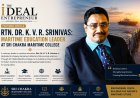
Rtn. Dr. K. V. R. Srinivas: Maritime Education Leader at Sri Chakra Maritime College
Rtn. Dr. K. V. R. Srinivas: Maritime Education Leader at Sri Chakra Maritime College
 admin
admin
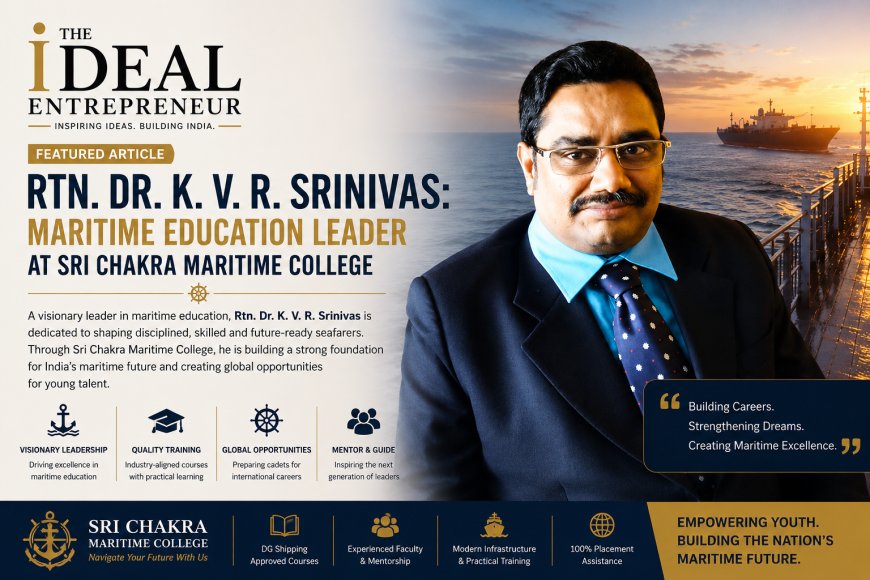
Managing Director, Sri Chakra Maritime College | Maritime Education & Training | Puducherry
“Maritime education is not only about preparing students for examinations. It is about preparing them for responsibility, discipline and life at sea.”
A career at sea demands much more than technical knowledge.
It demands discipline, confidence, teamwork, safety awareness and the ability to perform responsibly in an international working environment.
For Rtn. Dr. K. V. R. Srinivas, Managing Director of Sri Chakra Maritime College, these principles are central to the institution's approach to maritime education.
Located in the Moratandi–Pattanur region near Puducherry, Sri Chakra Maritime College provides maritime-focused training designed to help aspiring seafarers develop the knowledge and practical foundation required for professional careers.
Its programmes include General Purpose Rating (GP Rating), Orientation Course for Catering Personnel (OCCP) and STCW-related training, creating pathways for students interested in different areas of the maritime industry.
The college is currently promoting admissions for its January 2027 GP Rating intake, with a focus on practical training, experienced faculty and career readiness.
From Education to Professional Readiness
Maritime education occupies a unique position.
A student may begin in a classroom, but the eventual workplace can be a vessel operating thousands of kilometres from home.
That transition requires preparation.
Students must learn to understand procedures, work within teams, follow safety requirements and adapt to an environment where discipline is part of everyday professional life.
Sri Chakra Maritime College positions itself around this transition.
Its stated educational pillars include:
- Industry-driven curriculum
- Experienced faculty
- Practical learning
- Career-placement assistance
- Individual student care
The objective is to create an educational environment in which students do not simply acquire information, but begin developing professional awareness.
Leadership at Sri Chakra Maritime College
Rtn. Dr. K. V. R. Srinivas is identified in the supplied institutional material as the Managing Director of Sri Chakra Maritime College.
Separate faculty material identifies Mr. K. V. R. Srinivas as Director. Both designations have been retained because they appear in the supplied institutional information.
Rather than attributing additional personal achievements or qualifications that are not established in the available material, this profile focuses on his documented institutional leadership and the educational vision presented by the college.
His role places him at the intersection of education, administration, student development and the professional requirements of the maritime sector.
Building a Career-Oriented Institution
The college's educational philosophy is built around connecting academic learning with professional realities.
Its curriculum is described as industry-driven, while case studies, assignments, presentations and practical scenarios form part of the learning process.
This is particularly relevant to maritime training.
A seafarer must eventually operate in an environment where decisions can have practical consequences.
Technical knowledge must therefore be supported by:
Discipline.
Teamwork.
Communication.
Safety awareness.
Responsibility.
Professional conduct.
For students preparing to enter the maritime sector, these qualities can be just as important as theoretical understanding.
GP Rating: A Pathway Into Maritime Careers
One of the college's principal programmes is General Purpose Rating (GP Rating).
According to the supplied institutional information, the programme is a six-month pre-sea training course approved by the Directorate General of Shipping, Government of India.
The programme is designed for students seeking entry-level opportunities within the maritime sector.
The current institutional admission campaign promotes the:
January 2027 GP Rating Intake
For aspiring seafarers, pre-sea training represents an important stage between education and the professional environment aboard a vessel.
The emphasis is therefore not simply on completing a course.
It is on developing the foundational knowledge and professional discipline required before entering the maritime workplace.
Learning Beyond the Classroom
A maritime classroom can teach principles.
Practical training helps students understand how those principles apply.
Sri Chakra Maritime College highlights the use of real-world scenarios and case studies within its educational approach.
This kind of learning can help students understand why procedures matter and how professional decisions are made.
The college also describes its faculty as experienced maritime professionals who bring practical industry knowledge into the learning environment.
For students, that creates an important connection:
Experience from the sea → knowledge in the classroom → preparation for the profession.
The Strength of Experienced Faculty
One of the notable features highlighted by Sri Chakra Maritime College is the professional background of its faculty.
The supplied institutional information lists several senior maritime professionals with extensive sea-going and teaching experience.
Capt. Raman Jayaram
Identified as Vice Principal and GSK Faculty, with approximately 42 years of sea experience and around eight years of teaching experience.
Capt. Sajeev Balan
Identified as Principal and Course In-charge, with approximately 28 years of sea experience and around 11 years of teaching experience.
Mr. Basanta Kumar Mahalik
Identified as MEK Faculty and GP Course In-charge, with approximately 25 years of sea experience and around 15 years of teaching experience.
Mr. Ragunathan
Identified as MEK Faculty, with approximately 17 years of sea experience and around five years of teaching experience.
These figures are reproduced from the supplied institutional faculty information.
The combination of professional maritime experience and teaching experience provides students with access to instructors who have spent substantial time understanding the realities of shipboard operations.
Turning Experience Into Education
For a young student, maritime terminology and procedures can initially appear abstract.
Experienced instructors can help explain why those procedures exist.
They can connect classroom concepts with situations encountered during real operations.
That connection can make education more meaningful.
Sri Chakra Maritime College states that its faculty participate in activities such as:
- Curriculum reviews
- Professional-development programmes
- Seminars
- Conferences
- Workshops
The stated objective is to keep learning aligned with evolving professional requirements.
STCW: Understanding International Maritime Standards
Maritime careers operate within an international regulatory environment.
One of the key frameworks is STCW — Standards of Training, Certification and Watchkeeping for Seafarers.
STCW establishes important international standards relating to seafarer training, certification and watchkeeping.
Sri Chakra Maritime College includes STCW-related training among its educational offerings.
For students and working seafarers, understanding these standards is an essential part of professional preparation.
Maritime education therefore exists within a wider framework of:
Training → Certification → Safety → Professional responsibility.
Maritime Careers Are Bigger Than Navigation
When people think about merchant navy careers, they often imagine navigation, ships and engineering.
But a vessel requires many different professionals.
Sri Chakra Maritime College's Orientation Course for Catering Personnel (OCCP) demonstrates this broader career ecosystem.
The programme is intended for candidates interested in maritime catering-related roles, including students with backgrounds in hotel management and catering.
This highlights an important fact:
The maritime industry requires professionals from multiple disciplines.
A career at sea can therefore take different forms depending on a student's interests, qualifications and training pathway.
Career Guidance and Student Support
Training is only one stage of becoming a maritime professional.
Students also need to understand potential career pathways, industry expectations and professional opportunities.
Sri Chakra Maritime College highlights career-placement assistance as part of its institutional offering.
The college also promotes individual care for students, presenting personalised support as part of its educational approach.
No specific placement percentage or employment guarantee is stated here because such claims were not independently established in the supplied information.
For prospective students, current placement information should always be verified directly with the institution.
Creating a Student-Centred Environment
The college describes its campus as a green and garden-like environment in the Moratandi–Pattanur area near Puducherry.
The setting provides students with an educational environment outside the intensity of a major urban centre.
The institution's promotional material also highlights Puducherry's cultural identity and historical character.
For students living away from home, the campus environment can become an important part of their overall educational experience.
The Global Nature of Maritime Careers
Maritime employment is inherently international.
Ships travel across borders.
Crews can include people from different countries.
Seafarers may visit ports across different regions of the world.
This creates professional exposure that few conventional careers can replicate.
Sri Chakra Maritime College highlights worldwide exposure as one of the attractions associated with merchant navy careers.
Its student-facing material also refers to factors such as financial independence, vacation periods and personality development.
These should be understood as institutional career messaging rather than guarantees of employment, salary or working conditions.
Discipline as a Professional Skill
In maritime operations, discipline is not simply a personal quality.
It is part of professional safety.
Ships operate through procedures, communication systems and clearly defined responsibilities.
A professional must know when to act, how to communicate and how to follow established safety requirements.
This is why maritime education has a responsibility beyond technical instruction.
It must also encourage the development of:
Responsibility.
Teamwork.
Adaptability.
Professional discipline.
Safety consciousness.
These qualities help students understand the environment they may eventually enter.
Education Within a Regulated Sector
Maritime training is a highly regulated area.
Sri Chakra Maritime College's current website states that the institution is approved by the Directorate General of Shipping, Government of India and refers to ISO 9001:2015 certification in its current admission-facing material.
Another supplied institutional section references ISO 9001:2000. Since both references appear in the supplied material, the current certification version should be confirmed directly with the institution if this distinction is important.
Official regulatory records also identify the college as:
MTI No. 402017
The institution's regulatory history includes DG Shipping orders concerning GP Rating capacity and grading.
A DG Shipping order dated 22 November 2023 discussed an application for additional GP Rating training capacity and recorded that the application was not approved at that stage in connection with requirements concerning shipboard training and grading.
A subsequent DG Shipping order dated 26 February 2024 referred to GP Rating capacity and placement-related grading, recording a C-2 placement grading and B-2 overall grading following revision of CIP grading.
These documents form part of the institution's regulatory history and should not automatically be interpreted as describing its current approval, grading or capacity.
Prospective students should verify the latest status through current official regulatory records.
Transparency in Maritime Education
For students and parents, choosing a maritime training institution is an important decision.
Promotional claims and regulatory information should therefore be considered separately.
The available material surrounding Sri Chakra Maritime College includes:
- Institutional website information
- Faculty profiles
- Admission information
- Student-selection resources
- Student-success material
- DG Shipping records
- STCW-related records
This combination provides a broader picture of the institution.
The college communicates its current educational positioning, while official records provide regulatory context.
Both perspectives matter.
Celebrating Student Performance
Sri Chakra Maritime College also maintains resources showcasing student performance.
Its digital material includes selected student lists and a Top Rank Holders gallery.
The institution also publishes student-success videos and testimonials.
Such material offers insight into the experiences the college chooses to highlight publicly.
However, individual performance, examination results, placement outcomes and employment claims should be independently verified where specific evidence is required.
Preparing the Next Generation
The maritime industry continues to evolve.
Technology is changing ship operations.
International standards continue to develop.
Safety requirements remain critical.
Employers increasingly require professionals who can combine technical competence with adaptability and communication.
Training institutions therefore have to prepare students not only for the first job, but for an evolving professional career.
Sri Chakra Maritime College's stated approach — combining industry-oriented curriculum, experienced faculty, practical learning, career guidance and student support — is designed around this challenge.
January 2027: The Next Admission Cycle
The college's current admission campaign announces:
Admission Open for January 2027
The campaign particularly highlights the GP Rating course.
Its messaging emphasises:
Best Campus. Best Faculty. Best Environment. Individual Care for Each Student.
The admission material also states that a passport is mandatory.
Students and parents should confirm the latest:
- Eligibility requirements
- Documentation
- Course availability
- Fees
- Approval status
- Admission conditions
- Placement information
directly with the institution and relevant authorities before making an enrollment decision.
Leadership With a Long-Term View
Running a maritime training institution requires balancing several responsibilities.
There is the academic side.
There is administration.
There is regulatory compliance.
There is student welfare.
There is faculty management.
And there is the continuing need to understand the expectations of the maritime industry.
As Managing Director, Rtn. Dr. K. V. R. Srinivas is positioned within this institutional leadership structure.
The available material does not provide enough independently established information to construct a detailed personal biography beyond his institutional role.
What can be clearly understood is the environment in which his leadership operates: a regulated maritime-training institution focused on preparing young people for a demanding international profession.
The Road Ahead
For a young person considering a maritime career, the journey begins long before stepping aboard a ship.
It begins with a decision.
Then comes training.
Then discipline.
Then practical preparation.
Then professional certification.
And eventually, the transition into the maritime workplace.
Institutions such as Sri Chakra Maritime College occupy an important position in that journey.
Their responsibility is to create an environment where students can transform ambition into preparation and preparation into professional capability.
That journey requires teachers with experience, administrators with vision and students willing to work hard.
The FlexiMaps Perspective
The story of Sri Chakra Maritime College is ultimately about the connection between education and professional opportunity.
Maritime careers demand specialised knowledge, practical competence, discipline and safety awareness.
Through its GP Rating, OCCP and STCW-related programmes, experienced maritime faculty, practical-learning approach and career-oriented student support, the college presents itself as an institution focused on helping students prepare for that environment.
At the centre of its institutional leadership is Rtn. Dr. K. V. R. Srinivas, identified as Managing Director.
His role is connected with an institution operating within one of India's highly regulated professional-training sectors.
For aspiring seafarers, the first voyage does not begin at the port.
It begins in preparation.
And preparation begins with education.
Rtn. Dr. K. V. R. Srinivas
Managing Director — Sri Chakra Maritime College
Maritime Education • GP Rating • STCW Training • OCCP • Career-Oriented Maritime Training
MTI No.: 402017
Campus:
Tower Road, Moratandi, Pattanur, Vanur, Villupuram – 605101, near Puducherry, India
Administrative Office:
“RUSHIVARSHITAM” #2, Nagalingam Street, Sivagami Nagar, Gowrivakkam, Velacherry Main Road, Chennai – 600073, Tamil Nadu
Managing Director: +91 9840733113
General: +91 73973 91721 / +91 96775 34888
Email: md@srichakramaritimecollege.com / info@srichakramaritimecollege.com
Current Admission Focus: January 2027 GP Rating Intake
Sri Chakra Maritime College
Preparing Students Today for the Maritime Careers of Tomorrow.
— FlexiMaps Editorial Team