Madhurendra Kumar: The Indian Sand Artist Turning Sand, Leaves & Everyday Materials into Powerful Stories
Discover Madhurendra Kumar, the Indian sand artist and multidisciplinary creator transforming sand, leaves, waste and everyday materials into powerful stories of culture, environment and social awareness.
 admin
admin
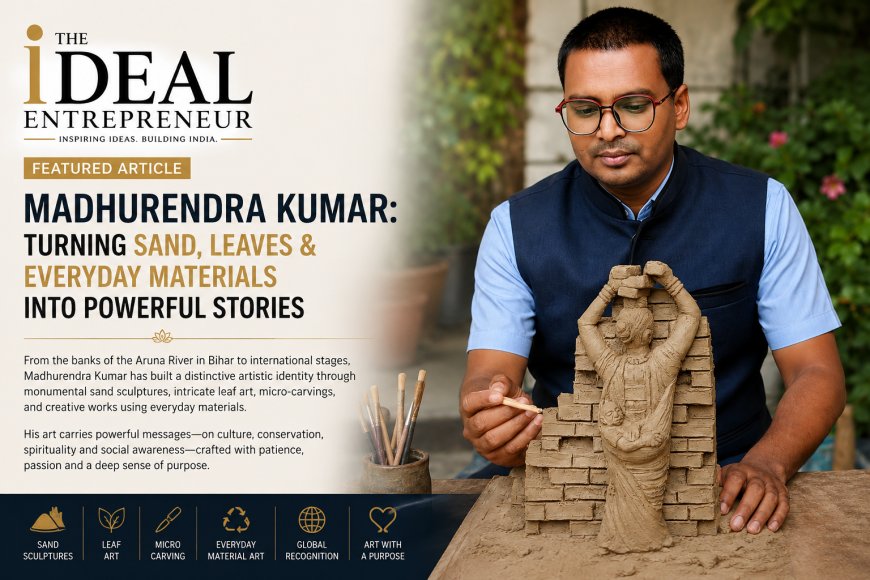
Madhurendra Kumar: Turning Sand, Leaves & Everyday Materials into Powerful Stories
Featured in The Ideal Entrepreneur – August Edition
Some artists work with canvas.
Some work with stone.
Others work with materials that most people would never imagine could become art.
For Madhurendra Kumar, sand, leaves, grains, fruits, vegetables, coal ash and recycled materials have become tools for storytelling.
An Indian sand artist, sculptor, painter and multidisciplinary artist from Bihar, Madhurendra has developed a distinctive artistic identity through monumental sand sculptures, micro-art, leaf carving, sculpture and socially driven installations.
Born on 5 September 1994 in Barwakala, Ghodasahan, East Champaran, Bihar, and raised in the nearby village of Bijbani, his relationship with art began during childhood beside the Aruna River.
What started as a child shaping mud and sand into small figures eventually evolved into an artistic journey spanning national exhibitions, public-awareness campaigns and international platforms.
Today, his work reflects a powerful combination of creativity, persistence, cultural storytelling and social awareness.
Where the Journey Began
Madhurendra Kumar's first studio was not a conventional art school.
It was a riverbank.
As a child, he experimented with clay and sand, creating simple figures of birds, animals and houses. The naturally available materials around him became his first artistic tools.
The Aruna River provided the sand.
The surrounding environment provided inspiration.
And his imagination provided the rest.
This early relationship with nature would eventually become one of the defining characteristics of his career.
Instead of seeing the limitations of his surroundings, Madhurendra discovered possibilities within them.
Growing Up With Limited Resources
Madhurendra's childhood was shaped by financial challenges.
His father, Shiv Kumar Sah, is described in his profile as a farmer, while his mother, Gena Devi, is associated with regional folk singing, knitting and traditional Sikki craft.
As the eldest among five siblings, Madhurendra experienced responsibilities from an early age.
His journey included agricultural work, livestock grazing and various forms of employment undertaken to support his education and artistic ambitions.
According to the supplied profile, he sold curd door-to-door, made bamboo baskets, sold vegetables, worked in hotels and at local fairs, painted houses and signboards, worked as a night guard and undertook survey-related work.
During his college years, financial difficulties reportedly became particularly severe, with periods when he could not afford hostel accommodation.
Yet art remained a constant.
Instead of abandoning his ambition, he continued learning and experimenting.
That persistence became one of the strongest foundations of his career.
From Sand to a Multidisciplinary Art Practice
Although Madhurendra is widely recognised as a sand artist, his creative practice extends far beyond sand.
Over the years, he has experimented with:
- Sand
- Clay
- Coal ash
- Cement
- Fibre
- Plaster of Paris
- Wax
- Copper
- Brass
- Aluminium
- Marble
- Granite
- Plywood
- Thermocol
- Grains
- Leaves
- Fruits
- Vegetables
- Recycled waste
This constant experimentation reflects a central principle in his artistic journey:
The material does not define the message. The artist does.
A giant sand sculpture can communicate a social issue.
A leaf can become a portrait.
A grain can become a miniature artwork.
Waste can become a warning about addiction.
Coal ash can become a cultural symbol.
Ordinary materials become extraordinary when imagination gives them meaning.
Art With a Purpose
Madhurendra's work frequently combines visual creativity with social messaging.
His artworks have addressed subjects including:
De-addiction.
Environmental conservation.
Water conservation.
Cleanliness.
Voter awareness.
Women's empowerment.
Peace and harmony.
Cultural heritage.
Public health.
Agriculture.
Tourism.
Social responsibility.
This approach has helped him create art that is not merely decorative.
It is communicative.
A viewer may stop because of the size or beauty of a sculpture, but the underlying message encourages them to think.
That combination of spectacle and awareness has become a defining element of his work.
The Monumental “Sarvadharm Ki Shahadat”
One of the major milestones in Madhurendra's early career came in 2005, when he created a massive sand sculpture in Bathinda, Punjab.
According to the supplied profile, the project used approximately 200 tonnes of sand, around 50 workers and nearly 15 days of work.
The sculpture, approximately 40–45 feet high and around 100 feet long, was based on the theme:
“Rashtra Ko Samarpit Sarvadharm Ki Shahadat”
The artwork honoured martyrs and communicated a message of national unity and religious harmony.
According to the supplied profile, former President Dr. A. P. J. Abdul Kalam appreciated the work.
For Madhurendra, this recognition became an important moment of encouragement.
A young artist from Bihar had begun attracting attention far beyond his immediate surroundings.
From Monumental Art to Micro-Art
One of the fascinating contrasts in Madhurendra's work is his ability to move between enormous public sculptures and extremely small artworks.
His practice includes micro-art created using grains, leaves, fruits and other unconventional materials.
In 2008, according to the supplied profile, he created a miniature representation of Goddess Durga using approximately 25,000 rice grains and 20,500 lentil grains, combined with wax.
The artwork demonstrated a completely different dimension of his artistic ability.
The scale changed.
The material changed.
But the attention to detail remained.
Turning Waste Into a Message
Madhurendra has also explored recycled waste as an artistic medium.
His work has incorporated materials associated with tobacco, alcohol and other forms of waste to create social-awareness sculptures.
One of his notable early works involved a human skeleton created using discarded materials such as liquor pouches, gutkha packets and cigarette remains.
The concept was straightforward:
The waste associated with addiction could become a visual warning about addiction.
Instead of hiding waste, the artwork placed it directly in front of the viewer.
The material became part of the message.
The Giant Spectacles
For World No Tobacco Day in 2009, Madhurendra created a giant pair of spectacles using thermocol.
According to the supplied profile, the structure was approximately 20 metres long and 10 feet high.
One side represented healthy eyes using fruits and vegetables.
The other represented damaged eyes through tobacco-related products and waste.
The installation connected health, nutrition and the consequences of tobacco consumption through a visual concept that could be understood immediately.
This ability to convert complex public-health messages into simple visual experiences remains an important characteristic of Madhurendra's art.
Taking Cultural Stories Into Sand
Madhurendra's work is not limited to contemporary social campaigns.
Indian culture, spirituality and history have also played a major role in his artistic expression.
His sculptures have represented:
- Buddha
- Mahavira
- Krishna
- Shiva
- Vishnu
- Mahatma Gandhi
- Indian historical figures
- Cultural traditions
- Classical dance
- Indian festivals
- Historical monuments
Through sand and other materials, he transforms cultural stories into visual experiences.
This allows traditional themes to reach audiences through a contemporary artistic medium.
Bihar's Sand-Art Identity
Madhurendra's journey is particularly significant because of his connection to Bihar.
Sand sculpture is often associated with coastal regions.
Bihar, however, is a landlocked state.
Madhurendra turned its rivers into his artistic landscape.
The Aruna, Ganga, Gandak, Kosi and Son river systems became important sources of sand and inspiration.
Over time, his work appeared at major cultural events across Bihar, including:
- Sonpur Mela
- Buddhist Festival, Bodh Gaya
- Rajgir Mahotsav
- Vaishali Mahotsav
- Thave Mahotsav
- Kesaria Mahotsav
- Mandar Mahotsav
- Pavapuri Mahotsav
- Kundalpur Mahotsav
- Agricultural and horticultural events
- Public-awareness programmes
His career has therefore become closely connected with Bihar's cultural and public-art landscape.
Sonpur Mela & Large-Scale Sand Art
The historic Sonpur Mela has been an important platform for Madhurendra's artistic work.
His supplied profile records repeated sand-art presentations at the festival, including artworks inspired by the Gaj-Grah episode.
The event provides a unique environment where traditional culture, public gatherings and contemporary art intersect.
For an artist focused on public storytelling, such platforms allow the artwork to reach audiences beyond conventional galleries.
Buddha & the Art of Storytelling
Buddhist themes have become another important part of Madhurendra's artistic journey.
His work at Bodh Gaya has explored the life and teachings of Buddha through sand sculpture.
According to the supplied profile, in 2026 he created 50 separate sand sculptures depicting different stages of Siddhartha Gautama's life, including Mahaparinirvana.
Rather than creating one sculpture, the project presented an artistic narrative.
Each sculpture became part of a larger story.
The approach demonstrates Madhurendra's interest in using art not simply to represent a person, but to communicate an entire journey.
A Giant Buddha at the Falgu River
Madhurendra has also created large-scale Buddha sculptures near the Falgu River in Bodh Gaya.
According to the supplied profile, a 2023 installation reached approximately 40–42 feet in height and focused on themes including peace, non-violence and harmony.
The project combined scale with spiritual symbolism.
It also reflected the artist's broader interest in creating public artworks that can communicate values to large audiences.
Art & Public Awareness
Another important part of Madhurendra's career has been his involvement in public-awareness campaigns.
His artwork has been associated with themes such as:
- Voter participation
- Cleanliness
- Water conservation
- Environmental protection
- De-addiction
- Public health
- Agriculture
- Tourism
- Women's empowerment
His approach is particularly effective for public campaigns because large-scale visual art can attract attention quickly.
A message written on a poster may be overlooked.
A massive sculpture in a public space can become a conversation.
Madhurendra uses that attention to create awareness.
Voter Awareness Through Art
According to the supplied profile, Madhurendra participated in voter-awareness initiatives associated with the 2019 Lok Sabha election and 2020 Bihar Assembly election.
His large sand sculptures were used to encourage citizens to participate in the democratic process.
The profile also identifies him with brand-ambassador roles associated with voter awareness.
This work demonstrates another dimension of his practice: using art as a tool for civic communication.
Art for Cleanliness
Madhurendra's public-art work has also supported cleanliness awareness.
His profile associates him with Swachh Survekshan campaigns and themes such as:
“Swachh Shahar, Swachh Gaon”
The objective was to communicate cleanliness through visual art.
Rather than relying solely on conventional awareness material, his sculptures created large public symbols that could attract attention and generate discussion.
Connecting Art With Agriculture
Madhurendra has also created artworks around agricultural products, rural communities and GI-tag awareness.
This work highlights the cultural and economic importance of regional agricultural identity.
Through sand sculpture and public installations, he seeks to communicate the value of local products and the communities behind them.
It represents another example of how his art connects creativity with public education.
A New Material: Coal Ash
Madhurendra's willingness to experiment has continued into recent years.
In January 2026, he created an approximately 15-foot Saraswati artwork using around 20 tonnes of coal ash in Bhagalpur, according to the supplied profile.
The artwork incorporated Saraswati with a veena, swan and peacock.
The use of coal ash introduced an industrial waste material into a cultural artwork.
It was another example of Madhurendra's ability to transform unconventional materials into meaningful visual forms.
The project attracted media attention and reinforced his continuing experimentation with materials.
Leaf Art: Precision on a Natural Canvas
Perhaps one of the most fascinating aspects of Madhurendra's practice is leaf art.
A leaf is fragile.
It can tear easily.
It provides very little space for error.
Yet Madhurendra has used leaves as canvases for detailed portraits and artistic compositions.
His profile associates his leaf-art practice with more than 21,000 artworks, alongside a claimed 2026 USA Book of World Records recognition.
In 2025, Hindustan reported his creation of a portrait of Padma Shri Godavari Dutt on a peepal leaf as a tribute to the Madhubani artist.
The work demonstrated the connection between two artistic traditions emerging from Bihar: Madhubani art and contemporary micro-art.
Fruit & Vegetable Carving
Madhurendra's artistic experimentation also extends into food materials.
He has created detailed artworks and portraits using:
- Watermelons
- Papayas
- Mangoes
- Oranges
- Lemons
- Amla
- Carrots
- Other vegetables
These works transform temporary everyday objects into artistic surfaces.
They also demonstrate his belief that art does not necessarily require expensive materials.
Creativity can begin with whatever is available.
From Bihar to International Platforms
Madhurendra's career has gradually expanded beyond India.
According to the supplied profile, he has represented India more than 75 times across 25+ countries and received more than 50 international recognitions.
The countries listed in his supplied profile include nations across Asia, Europe, the Middle East, North America and other regions.
His international work has included:
- Sand sculpture festivals
- International competitions
- Cultural events
- Art exhibitions
- Environmental campaigns
- Social-awareness programmes
- Cross-cultural artistic projects
A 2020 Times of India report also documented his participation in the International Sand Art Festival in Odisha, highlighting his journey from East Champaran to an international platform.
Recognition Across India & Abroad
According to the supplied profile, Madhurendra has received more than 100 national honours and numerous international awards.
His listed recognitions include awards connected with:
- Sand art
- Cultural representation
- Social awareness
- Environmental messaging
- International art festivals
- Public art
- Youth achievement
- Bihar's cultural identity
His profile also lists multiple record-book titles.
Because individual record organisations and certificates are not independently verified here, these recognitions are best understood as claims supplied in the artist's profile rather than independently verified facts.
Education & Artistic Training
Madhurendra's formal artistic education includes a strong foundation in sculpture.
He completed his BFA and MFA in Sculpture from Mahatma Gandhi Kashi Vidyapith, Varanasi.
His educational journey also included earlier studies in Hindi and additional training in painting and drawing.
According to the supplied profile, his qualifications include training associated with:
- Fine Arts
- Painting
- Sculpture
- Computer applications
- Land surveying
- Drawing examinations
- Karate
This combination of formal education and practical experimentation has contributed to his multidisciplinary approach.
An Honorary Doctorate
According to the supplied profile, Madhurendra Kumar received an Honorary Doctor of Philosophy in Sand Art in 2026 from America International University (AIU), Hollywood, California, USA.
The recognition was described as acknowledging his contribution to sand art.
A 2026 profile also reported the honorary doctorate as a recent milestone in his career.
More Than an Artist: Building an Ecosystem
Madhurendra's ambitions extend beyond creating his own artwork.
He wants to help create opportunities for young artists.
According to his supplied profile, he established Madhurendra Ki Kala Evam Shilp Anusandhan Sansthan, with the aim of helping children and young people from economically weaker backgrounds learn art and craft skills.
This reflects an important transition in his journey.
He is no longer thinking only about:
What can I create?
He is also asking:
What can I teach?
Who else can I help create?
The Gurukul Vision
One of Madhurendra's future ambitions is the development of a Gurukul-inspired art education model.
The proposed approach would combine traditional learning with practical artistic training.
Potential areas include:
- Sand art
- 3D sand art
- Leaf art
- Fruit and vegetable carving
- Sculpture
- Painting
- Bamboo craft
- Sikki craft
- Munj craft
- Basket making
- Textile craft
- Sewing and design
- Public art
- Environmental art
The objective is to make artistic skills more accessible to children who may not have the financial resources to attend expensive art institutions.
Creating Artists, Not Just Artworks
This may ultimately become one of the most meaningful chapters of Madhurendra's career.
His own journey demonstrates what can happen when a young person discovers an artistic ability despite limited resources.
He wants to create similar opportunities for others.
The proposed academy would aim to provide training, mentorship and practical exposure so that young people can turn artistic skills into sustainable livelihoods.
For Madhurendra, art can become more than expression.
It can become education, employment and empowerment.
The Philosophy Behind His Work
Three qualities stand out throughout Madhurendra Kumar's journey.
Resourcefulness
When conventional materials were unavailable, he used sand, clay, leaves, grains, waste and whatever else was accessible.
Persistence
Financial difficulties and personal challenges did not stop him from continuing his artistic education and experimentation.
Purpose
His artwork frequently carries a social, environmental, cultural or public-awareness message.
Together, these qualities have shaped a career that is both creative and socially conscious.
The Entrepreneurial Side of an Artist
Although Madhurendra is primarily known for his artistic work, his journey also contains important lessons in entrepreneurship.
He has built a personal brand around a distinctive skill.
He has developed multiple artistic mediums.
He has worked with public institutions and cultural organisations.
He has participated in international events.
He has developed educational ambitions.
And he continues to search for new materials and new audiences.
This is a form of creative entrepreneurship.
The product is not simply an object.
It is an experience.
A message.
A cultural story.
A public conversation.
The Road Ahead
Madhurendra's future plans reflect the same spirit that shaped his childhood.
He wants to continue experimenting with materials.
He wants to promote Indian art internationally.
He wants to create environmental-awareness artworks.
He wants to document his artistic techniques.
He wants to develop educational programmes.
And most importantly, he wants to help young people discover their own creative potential.
His vision therefore extends beyond creating the next giant sculpture.
It is about creating a sustainable ecosystem around art.
The Ideal Entrepreneur Perspective
Entrepreneurship does not always begin with capital.
Sometimes it begins with curiosity.
Sometimes it begins with a skill.
Sometimes it begins beside a river, with a handful of sand and a child wondering what can be created from it.
Madhurendra Kumar's journey represents this form of entrepreneurship.
He transformed an accessible natural material into a professional artistic medium.
He expanded from sand into leaves, grains, fruits, vegetables, wax, wood, metal, recycled materials and coal ash.
He transformed art into public awareness.
He transformed personal recognition into an ambition to educate others.
And he transformed the limitations of his childhood into the foundation of an international artistic identity.
From East Champaran to international stages, his journey is ultimately a story of imagination meeting persistence.
For The Ideal Entrepreneur, Madhurendra Kumar represents a powerful reminder:
You do not always need extraordinary resources to create something extraordinary.
Sometimes, you simply need the ability to see extraordinary possibilities in ordinary things.
Madhurendra Kumar
Indian Sand Artist | Sculptor | Painter | Multidisciplinary Artist
Known For:
Sand Art | Leaf Art | Micro Art | Sculpture | Fruit & Vegetable Carving | Social Awareness Art | Environmental Art
Education:
BFA & MFA in Sculpture, Mahatma Gandhi Kashi Vidyapith, Varanasi
International Presence:
25+ countries, according to supplied profile
International Recognitions:
50+ awards, according to supplied profile
National Recognitions:
100+ awards, according to supplied profile
Featured in:
The Ideal Entrepreneur – August Edition
“When the material is ordinary, imagination becomes the extraordinary.”
— The Ideal Entrepreneur Editorial Team