Sathya Sunil: Founder of Kidz N Brainz | Spark Method™
Discover Sathya Sunil, Founder of Kidz N Brainz, and her mission to develop children's skills through Abacus, Vedic Maths, memory training and creative learning.
 admin
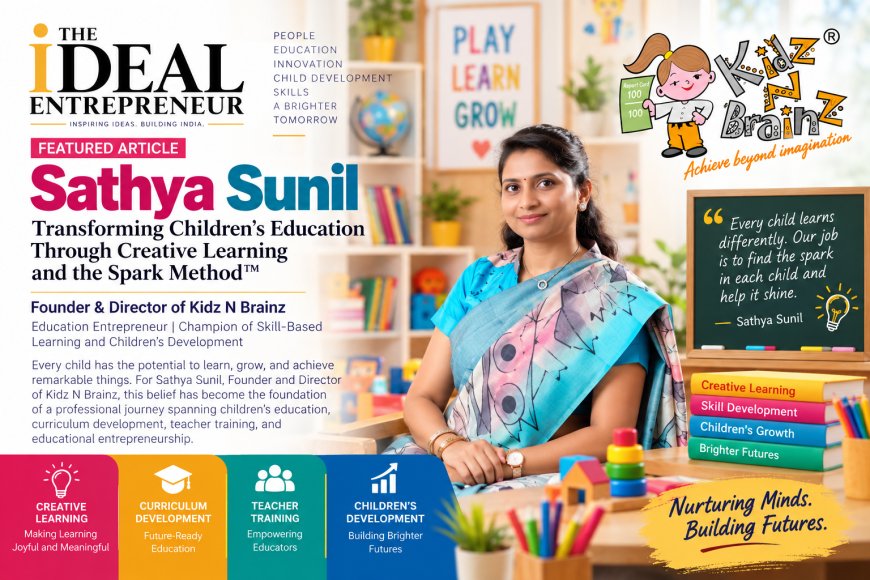
Sathya Sunil: Transforming Children's Education Through Creative Learning and the Spark Method™
Founder & Director of Kidz N Brainz | Education Entrepreneur | Champion of Skill-Based Learning and Children's Development
Every child has the potential to learn, grow, and achieve remarkable things. The challenge is to create the right environment in which that potential can flourish. For Sathya Sunil, Founder and Director of Kidz N Brainz, this belief has become the foundation of a professional journey spanning children's education, curriculum development, teacher training, and educational entrepreneurship.
Founded in 2005, Kidz N Brainz is an educational institution offering extracurricular learning programs designed to help children develop mathematical fluency, memory techniques, language skills, concentration, creative expression, and logical reasoning. Its educational philosophy brings together structured practice, engaging activities, and progressive learning experiences to encourage children to become more confident and independent learners.
With an academic background in science, a master's qualification in education management, and a master's degree in English literature, Sathya brings together multiple perspectives on teaching and learning. According to the institutional information provided, she has personally written and designed the courses offered by Kidz N Brainz, reflecting her commitment to developing an educational model aligned with her vision.
Over the years, the institution has expanded its portfolio to include Abacus, Vedic Maths, Memory Boosters, Handwriting, Calligraphy, Kidz English, and Rubik's Cube. Its reported network includes more than 50 learning centers across South India, while current institutional materials cite over 60 centers across India.
Beyond children's education, Kidz N Brainz has also developed a franchise model that creates opportunities for teachers and aspiring entrepreneurs, particularly women interested in building education-related businesses.
For Sathya Sunil, the ultimate objective extends beyond teaching individual subjects. It is about helping children discover their abilities, develop useful learning strategies, and approach new challenges with curiosity and confidence.
A Vision Born from One Belief: Every Child Has Unlimited Potential
Every educational journey begins with a belief about what children can achieve. For Sathya Sunil, that belief became the foundation of Kidz N Brainz.
When she established the institution in 2005, her vision was to create learning opportunities that extended beyond conventional classroom instruction. She recognised that children benefit from experiences that encourage them to explore different approaches to learning, practise new skills, and gradually become more comfortable with unfamiliar challenges.
School education provides the essential foundation for academic development. However, children can also benefit from extracurricular activities that encourage numerical understanding, pattern recognition, memory, written expression, communication, and problem-solving.
This understanding influenced the direction of Kidz N Brainz.
Rather than concentrating exclusively on academic content, the institution developed programs intended to help children practise specific skills through structured exercises and progressive learning activities.
Its approach recognises that children learn at different speeds and have different interests. An engaging learning environment can give them opportunities to practise, ask questions, correct mistakes, and build confidence through consistent effort.
Sathya's academic background in science, education management, and English literature provides a multidisciplinary foundation for this work. Her professional interests bring together structured thinking, educational planning, language development, and the importance of making learning accessible to children.
A distinctive feature of her journey is her involvement in developing the institution's courses. By writing and designing its learning materials, she has helped establish a curriculum-led educational model shaped by the institution's own philosophy.
The central objective remains consistent: create opportunities for children to learn, practise, and discover their potential.
From a Founder-Led Initiative to an Educational Institution
Establishing an educational institution requires more than a collection of courses. It involves developing teaching materials, organising lessons, supporting instructors, communicating with parents, and maintaining consistency as the institution grows.
For Sathya Sunil, founding Kidz N Brainz in 2005 marked the beginning of a long-term commitment to children's extracurricular education and skill development.
The institution initially focused on providing structured learning experiences in areas such as Abacus and other skill-based activities. These programs offered children opportunities to practise mathematical concepts and develop familiarity with techniques that differed from their usual classroom routines.
As the institution developed, its course portfolio expanded to address additional learning interests and abilities.
Abacus and Vedic Maths introduce alternative approaches to numerical calculation. Memory Boosters explores techniques for organising and recalling information. Handwriting and Calligraphy focus on penmanship and lettering, while Kidz English supports language development. Rubik's Cube activities introduce children to sequences, spatial relationships, and logical problem-solving.
Although these programs differ in subject matter, they share a common educational objective: encourage children to develop skills through guided practice.
Building an institution around this philosophy requires sustained attention to curriculum design, teacher preparation, parent communication, and the experience children receive at each learning center.
The development of Kidz N Brainz into a multi-center institution represents the next stage of this journey, extending its educational programs beyond a single location.
The Spark Method™: Encouraging Children to Think Independently
At the heart of Kidz N Brainz is its stated educational philosophy, known as The Spark Method™.
The method draws a distinction between teaching children what to think and helping them understand how to think.
The philosophy emphasises that learning should involve more than memorising information or following instructions. Children should also have opportunities to recognise patterns, explore methods, practise problem-solving, and develop strategies that they can apply to unfamiliar questions.
The Spark Method™ connects traditional Indian mathematical learning approaches, structured skill development, and activities associated with cognitive learning.
Abacus practice offers a visual and structured way to work with numbers. Vedic Maths introduces alternative calculation techniques. Memory exercises explore methods for organising and recalling information, while Rubik's Cube activities involve sequences, spatial relationships, and logical reasoning.
Within Kidz N Brainz, these programs contribute to a broader learning philosophy focused on helping children practise skills through progressive exercises.
Learning Beyond Memorisation
Memorisation has a place in education, but effective learning also involves understanding relationships, recognising patterns, and applying knowledge in different situations.
A child learning mental arithmetic, for example, may begin by practising basic operations before progressing to more complex calculations. As familiarity increases, the child can focus on accuracy, speed, and selecting an appropriate method.
Similarly, memory techniques can introduce children to ways of organising information instead of relying exclusively on repeated reading.
The Spark Method™ reflects this emphasis on developing learning strategies alongside subject-specific skills.
The Importance of Practice and Consistency
Skill development takes time. Children need opportunities to practise, receive feedback, correct mistakes, and gradually become comfortable with new techniques.
Kidz N Brainz structures its programs around progressive levels and regular sessions, allowing learners to become familiar with material before moving toward more advanced activities.
The institution's approach also recognises that children have different starting points and learning needs. Progress depends on factors such as age, previous experience, participation, and practice.
The Spark Method™ connects the institution's different courses under one central idea: education should equip children with useful strategies for approaching learning challenges.
Seven Learning Programs Designed for Different Skills
Kidz N Brainz offers seven principal programs covering different aspects of children's extracurricular learning.
1. Abacus: Building Numerical Fluency
The Abacus program is one of the institution's central offerings.
Designed for children in the approximate age range of four to twelve years, the program introduces learners to an abacus-based approach to arithmetic and progresses toward more advanced calculations.
The course covers foundational numerical operations before moving through additional levels of practice.
Working with an abacus gives children a visual and physical way to represent numbers and practise calculations. As they become familiar with the system, they can work toward performing calculations mentally using techniques introduced during training.
The program emphasises numerical practice, concentration, speed, and accuracy.
According to the supplied course information, sessions are structured around approximately two hours per week, with progression through different levels.
The objective is to help children become more comfortable working with numbers and develop confidence through regular practice.
2. Vedic Maths: Exploring Alternative Calculation Techniques
The Vedic Maths program introduces children to mathematical techniques associated with traditional Indian mathematical learning.
The supplied course information refers to an approximate age range of seven to fourteen years, with learning pathways designed for different stages.
Vedic Maths uses a collection of techniques and sutras that can provide alternative approaches to calculations involving multiplication, division, squares, and other mathematical operations.
For learners who become familiar with these methods, the techniques can offer additional ways to approach numerical problems.
The Kidz N Brainz program is described as having three levels, each lasting approximately three months, with around two hours of instruction per week.
The course encourages children to explore different calculation methods, compare approaches, and practise selecting techniques appropriate to a problem.
3. Memory Boosters: Developing Study and Recall Strategies
Memory Boosters introduces children to techniques for organising, retaining, and recalling information.
The supplied program information references approaches such as SQ3R, the method of loci, calendar techniques, and speed reading.
SQ3R is a structured reading and study method involving surveying, questioning, reading, reciting, and reviewing. The method of loci uses imagined locations and associations to help organise information for recall.
Other exercises encourage learners to create meaningful connections between information rather than approaching every fact as an isolated item.
For schoolchildren, these methods can provide additional strategies for organising study material, revising lessons, and practising recall.
The supplied course details identify Memory Boosters as a program for children approximately five to twelve years old, with particular techniques associated with older learners.
Sessions are described as approximately two hours per week.
The program aims to introduce practical study strategies that children can practise and adapt to their learning needs. Individual results vary, and no particular level of improvement should be assumed for every learner.
4. Handwriting: Developing Confident Written Expression
Handwriting remains an important part of early education, particularly as children begin completing written assignments and examinations.
Kidz N Brainz offers a handwriting program focused on cursive letter formation, writing rhythm, and the development of more fluent penmanship.
The supplied course information identifies a general age range of approximately three to eight years, with activities designed for different learning stages.
Level 1 focuses on cursive letter formation, while Level 2 develops writing speed and rhythm.
The program provides opportunities for children to practise letter shapes, improve consistency, and become more comfortable with written work.
Developing handwriting involves repetition, appropriate guidance, and time. The program aims to make this process structured and accessible, helping children establish a foundation for everyday written communication.
5. Calligraphy: Combining Writing with Artistic Expression
Calligraphy introduces children to the artistic side of writing.
Unlike everyday handwriting, calligraphy focuses on the visual form of letters, the arrangement of strokes, and the relationship between lettering and design.
The Kidz N Brainz program introduces learners to styles including Gothic, Copperplate, and Uncial.
The supplied course information references more than thirty lettering styles and two levels, each lasting approximately three months. Sessions are described as around one and a half hours per week.
Through guided practice, children explore how different writing styles are formed and how letter shape, spacing, and stroke influence the appearance of written work.
Calligraphy also provides opportunities for creative expression. It encourages learners to observe details, practise controlled movements, and develop patience.
The program is intended for children aged approximately eight years and above.
6. Kidz English: Strengthening Language and Communication
Kidz English is designed to support children's development in reading, vocabulary, grammar, and creative expression.
The supplied course information describes more than five learning levels, progressing from kindergarten-level learning through approximately seventh standard.
A structured language program can help children practise foundational skills while gradually developing greater familiarity with written and spoken English.
Reading activities introduce learners to words and sentence structures. Vocabulary exercises help them understand and use language, while grammar activities explore how words and sentences work together.
Creative exercises encourage children to express ideas in their own words.
Language development is particularly important because reading comprehension and communication skills support learning across many school subjects.
The program's objective is to provide children with opportunities to strengthen their language foundations through guided practice.
7. Solving the Cube: Introducing Logic and Spatial Reasoning
The Rubik's Cube program introduces children to a puzzle involving spatial relationships, sequences, and algorithmic thinking.
Solving the cube requires learners to understand how movements affect the arrangement of coloured faces and to practise sequences that gradually bring the puzzle toward a solved state.
At Kidz N Brainz, the course introduces children to the logic and techniques involved in solving the cube.
The supplied course information identifies an approximate age range of six to fourteen years and a duration of three months, with around one hour of instruction per week.
Children practise recognising patterns, following sequences, and understanding how individual moves affect the larger puzzle.
The activity can also encourage persistence. Learners may need to repeat a sequence, reconsider an approach, and practise until they understand the relationship between the steps.
The program provides an engaging way to introduce logical problem-solving and three-dimensional reasoning through a familiar puzzle.
Growing Beyond Bengaluru: Building a Learning Network
Kidz N Brainz is based in Indiranagar, Bengaluru, and has developed a network of learning centers serving families across multiple locations.
The supplied institutional information refers to more than fifty centers across South India, while current promotional material cites over sixty centers across India.
This growth reflects the development of an educational model that can extend beyond the founder's original teaching environment.
Expanding an institution requires more than making courses available in additional locations. It involves maintaining teaching standards, preparing instructors, organising learning materials, communicating with parents, and creating a consistent experience across centers.
For children and families, the local learning environment matters. Teachers must understand the course structure, lessons need to be delivered appropriately, and parents need clarity about learning objectives and progress.
For the institution, a wider network creates opportunities to reach more learners while also introducing operational responsibilities.
Curriculum consistency, teacher support, center management, and parent relationships become increasingly important as the network grows.
Kidz N Brainz's development across multiple locations demonstrates the role of franchise and center-based expansion in its educational model.
Franchise Opportunities: Creating Educational Entrepreneurs
An important part of the Kidz N Brainz model is its franchise opportunity for aspiring education entrepreneurs.
According to the supplied business information, the institution provides training, course materials, and ongoing support to franchise partners. The model is intended for individuals interested in operating a center focused on children's skill development and extracurricular education.
A franchise-based model can allow an established educational concept to reach new communities through local operators who understand the needs of families in their area.
However, running a learning center also requires commitment. Franchisees must manage daily operations, communicate with parents, organise classes, support instructors, and maintain the expectations associated with the institution's programs.
For Kidz N Brainz, the franchise model is connected not only to expansion but also to creating opportunities for people interested in education.
The institution's supplied materials report that more than seventy women have become entrepreneurs through its franchise network and that more than four hundred teachers have been trained.
These figures highlight an important dimension of its work: the relationship between children's education, teaching opportunities, and women's economic participation.
Supporting Women Through Education Entrepreneurship
One notable aspect of Kidz N Brainz's journey is its focus on creating opportunities for women to work as teachers and establish education-related businesses.
The institution's supplied materials state that more than five hundred women have received employment opportunities and more than seventy women have become entrepreneurs through its franchise model.
For women returning to professional life after a career break, a local education center may provide an opportunity to use existing skills while developing a new professional direction.
For others, a franchise can offer a pathway into business ownership within a field connected to education and child development.
Laxmi Patil: Returning to Work Through an Abacus Center
Laxmi Patil, a Kidz N Brainz franchisee in Devarabisanahalli, Bengaluru, describes starting her Abacus teaching journey after a career gap that followed her work with Cisco in America.
According to her testimonial, she began with eighteen students and later reached more than seventy.
Her experience highlights the potential for an educational franchise to provide a route back into professional activity while allowing an instructor to build relationships with children and parents in a local community.
Roopa P: Finding a New Professional Direction
Roopa P, a franchisee and instructor in JP Nagar, Bengaluru, shares how joining Kidz N Brainz in 2006 helped her move toward earning an income and developing a professional role.
Her testimonial describes the personal satisfaction she found through her association with the institution.
Her experience illustrates how teaching can provide an opportunity for women to participate in professional life while contributing to children's education.
JayaPriya: The Value of Teaching Resources and Support
JayaPriya, a franchisee and instructor in Chellagatta, highlights the support she receives from the institution's director.
Her testimonial describes Sathya Sunil as approachable and encouraging, and praises the course materials and learning environment.
Her account highlights the importance of resources, communication, and guidance when individuals operate an education center.
Chethana Reddy: Encouraging Children's Interest in Mathematics
Chethana Reddy, a franchisee in Davanagere, Karnataka, describes the role of Abacus learning in helping children become more comfortable with mathematics.
Her testimonial emphasises the value of encouraging interest in numbers and developing children's abilities through structured practice.
She also refers to students participating in an Open State Level Competition in Bengaluru.
These individual experiences illustrate the teaching, business, and community dimensions of the Kidz N Brainz network.
Parent Experiences: Learning Through Practice
Parents' experiences provide another perspective on how children engage with extracurricular learning.
The testimonials supplied by Kidz N Brainz describe experiences involving Abacus, Memory Boosters, English vocabulary, handwriting, and children's confidence in mathematics.
Raghu: A Structured and Child-Friendly Environment
Raghu, a General Manager at Wipro and parent of a child enrolled in Abacus, describes the institution as disciplined and supportive.
His testimonial highlights the combination of structured learning and an approach that remains considerate of children.
Sanjay Shete: Progress in Mathematics and English
Sanjay Shete, whose children Hansiya and Aadarsh attended Abacus and Kidz English, shares his observations about their learning experiences.
His testimonial describes his daughter becoming more comfortable completing mathematics within time limits and his son improving in English vocabulary and writing skills over the course of a year.
These are parent-reported observations rather than independently measured learning outcomes, but they provide insight into the experiences families associate with the programs.
Dhruv's Father: Developing an Interest in Mathematics
Another parent testimonial comes from Dhruv's father, who describes his son's experience with Abacus and Memory Boosters over nearly three years.
According to the testimonial, the child developed a stronger interest in mathematics and began applying memory techniques to school subjects.
These individual accounts demonstrate the different ways families describe their experiences with Kidz N Brainz. Results vary between learners, but parent feedback can provide useful context about the institution's teaching environment.
Awards and Recognition: A Journey Spanning Nearly Two Decades
Kidz N Brainz's supplied institutional materials list a series of awards and recognitions associated with its educational activities, franchise development, founder leadership, and student participation.
The chronology spans 2006 to 2025 and includes the following reported milestones. Award names and attributions below are reproduced from the information supplied by the institution and have not been independently verified for this article.
2006 – Best Franchisee Award
Associated with Ideal Play Abacus, Chennai, during the second State Level Competition. The supplied information identifies Town Hall, Bengaluru, as the venue.
2007 – Gold Star Performer Award
Associated with a state-level competition at Chennai Trade Center. The supplied information identifies Sharada Sriram and Chithra Ravindran as presenters.
2011 – Best Abacus & Calligraphy Institution, Bangalore
Listed under the Karnataka Service Excellence Awards, with the supplied materials attributing the recognition to Big Brands Research Academy.
2013 – Best Service in the Field of Abacus
Associated with Just Dial, Bengaluru. The supplied profile states that the recognition was based on parent reviews and ratings.
2016 – Achievement in Education Field
Listed under the Achievement in Business & Services Awards 2016 and attributed to Katalyst Research, New Delhi.
2016 – Contribution in the Education Sector
Associated with Vasavi Yuvajana Sangha during the Vasavi Suvarna Yuvajanothsava in Arsikere.
2017 – Pride of Arya Vysya
Listed under Entrepreneurial Excellence in Creative Education, with the supplied information associating the recognition with Malleshwaram 40 Plus.
2017 – Vasavi Excellence Award
Associated with Karnataka Aryavysya Mahasabha, Suvarna News Channel, and Kannada Prabha, according to the supplied information.
2018 – Indian Achiever's Award
Listed in the Educational Entrepreneur category and associated with the Indian Achiever's Forum at the Indian Habitat Centre, New Delhi.
2019 – 100 Achievers from Karnataka
The supplied profile states that Sathya Sunil was featured in a recognition associated with the launch of a biographical book at ADA Rangamandhira, Bengaluru.
2019 – Rajya Prashasthi Award
Associated with Samartha Sahitya & Samskruthika Prathisthana, according to the supplied information.
2019 – Top 10 Educational Websites for Kids, Pan India
Listed as a recognition associated with Silicon India Educational Magazine.
2020 – Best Indian Women Entrepreneur
Associated with Veloz Eve, described in the supplied materials as an international magazine based in Bengaluru.
2021 – India World Record
The supplied materials describe an online mass-record event in which 222 students completed 100 arithmetic sums in five minutes, with verification attributed to the IWR Foundation.
2023 – Mahila Manikya Award
Associated with Akila Karnataka AryaVysya Mahila Mahasabha, according to the supplied information.
2024 – Asian Admirable Achievers: 500 from Asia
Listed in connection with the publication 500 Achievers from Asia, associated with Rifacimento International.
2025 – Woman Achiever 2024
The supplied chronology identifies this recognition as presented in March 2025 and associates it with the International Women's Society.
These reported milestones cover educational service, entrepreneurship, digital education, student participation, and women's leadership.
The institution also describes itself as Karnataka's first ISO 9001-certified Abacus and Calligraphy institution. Its supplied information references ISO 9001:2008 certification; any statement about current certification should be supported by a current certificate and validity details.
Awards form one part of an institution's history. Its continuing educational contribution also depends on teaching quality, curriculum delivery, teacher development, student participation, and relationships with families.
The Role of Teachers in the Kidz N Brainz Model
An educational philosophy becomes meaningful through the people who deliver its programs.
Teachers help children understand new concepts, practise skills, and build confidence. Their responsibilities include explaining methods, identifying difficulties, encouraging effort, and adapting instruction to different learners.
For a multi-center institution, supporting teachers becomes an important operational priority.
The supplied institutional materials state that Kidz N Brainz has trained more than four hundred teachers and provided employment opportunities to more than five hundred women.
Training and course materials can help instructors become familiar with the institution's teaching approach. Ongoing support can also help center operators manage classes, communicate with parents, and maintain consistency.
The experiences shared by franchisees suggest that the relationship between the director, instructors, and local centers forms an important part of the institution's wider network.
For Sathya Sunil, developing teachers and franchisees is closely connected to the opportunity to bring the institution's programs to more children.
A Community Built Around Children and Families
Kidz N Brainz's development is also connected to its relationships with parents and families.
Parents often evaluate extracurricular programs through several considerations: whether their children enjoy learning, whether the teaching approach is suitable, whether classes fit their schedules, and whether the program supports skills they value.
The institution's testimonials describe experiences involving Abacus, Memory Boosters, English, handwriting, and mathematics.
Some parents report improvements in their children's confidence and engagement with learning. Others highlight the value of disciplined instruction and supportive teachers.
Such feedback represents individual experiences and should not be interpreted as a guarantee of results for every child. Nevertheless, parent perspectives can provide useful context about the institution's learning environment.
The institution's supplied materials also describe a free 45-minute campus visit, allowing parents and children to meet teachers, observe a class, and ask questions before deciding whether a program is suitable.
Clear communication, realistic expectations, and an understanding of each child's needs are essential to a strong relationship between an educational institution and its families.
The Future of Kidz N Brainz: Learning Beyond the Classroom
Sathya Sunil founded Kidz N Brainz in 2005 with the belief that every child has unlimited potential.
The institution's continuing direction focuses on extracurricular learning, skill development, and helping children approach challenges with confidence.
The educational landscape continues to evolve, but foundational abilities such as reading, numerical fluency, memory, concentration, communication, and problem-solving remain important.
Kidz N Brainz's seven-program portfolio gives families different ways to explore these skills outside conventional classroom learning.
Its continued development will depend on the quality of teaching, the effectiveness of learning materials, the support available to instructors, and the ability of centers to respond to the needs of children and families.
The franchise model also creates opportunities to extend the institution's reach while supporting individuals who want to work in education.
For Sathya Sunil, the next chapter involves building on the foundation established in 2005, strengthening the learning network, and supporting more children through structured educational experiences.
Sathya Sunil: Building a Lasting Contribution to Children's Education
The story of Sathya Sunil is one of educational vision, curriculum development, and entrepreneurship.
With academic qualifications in science, education management, and English literature, she brought a multidisciplinary background to the establishment of Kidz N Brainz.
Founded in 2005, the institution grew around her belief that children should have opportunities to develop their abilities through structured and engaging learning experiences.
Its programs in Abacus, Vedic Maths, Memory Boosters, Handwriting, Calligraphy, Kidz English, and Rubik's Cube address different aspects of skill development while sharing a broader focus on practice, confidence, and independent thinking.
The Spark Method™ expresses this philosophy through its emphasis on helping children develop strategies for learning and problem-solving rather than focusing exclusively on memorisation.
Kidz N Brainz has also developed a franchise model that, according to its supplied materials, has created opportunities for women teachers and entrepreneurs. Its reported network of more than fifty centers, with current materials citing over sixty centers, reflects the institution's expansion beyond Bengaluru.
The awards and recognitions listed by the institution between 2006 and 2025 form another part of its professional history.
Ultimately, an educational institution's contribution is shaped by the experiences it creates for children, the support it provides to teachers, and the relationships it builds with families.
For Sathya Sunil, the journey continues to be guided by a simple idea: children have the potential to learn, grow, and discover abilities that may not yet be apparent.
By creating structured opportunities for children to explore mathematics, memory, language, handwriting, and problem-solving, she is working to make extracurricular education a meaningful part of their development.
Her vision reaches beyond teaching a subject or completing a course. It is about helping children develop the confidence to approach unfamiliar challenges, the curiosity to keep learning, and the skills to discover their own potential.
For Kidz N Brainz, the next chapter builds on a journey that began in 2005—with a continuing commitment to children, education, and the possibilities that thoughtful learning can create.
The FlexiMaps Perspective
At FlexiMaps, we believe that meaningful educational leadership involves creating opportunities for children to discover their abilities and for educators to make a lasting contribution to their communities.
Sathya Sunil's journey reflects this commitment through the development of Kidz N Brainz, an institution that brings together extracurricular education, curriculum development, teacher training, and educational entrepreneurship.
From its establishment in 2005 to its expanding network of learning centers, Kidz N Brainz has built its identity around the belief that children benefit from engaging, structured opportunities to practise skills and explore different ways of learning.
The Spark Method™ expresses that philosophy by encouraging children to develop learning strategies, approach problems thoughtfully, and build confidence through practice.
The institution's franchise model adds another dimension to the journey, creating opportunities for teachers and aspiring entrepreneurs to participate in children's education.
As Kidz N Brainz continues to develop, its long-term contribution will be shaped by the quality of its programs, the support it provides to educators, and the learning experiences it creates for children.
For Sathya Sunil, the central mission remains clear: help children recognise their potential, give them opportunities to develop their skills, and encourage them to approach learning with confidence and curiosity.
Because education is not only about what children learn today—it is also about the skills, confidence, and curiosity they carry into tomorrow.
Kidz N Brainz – Institutional Profile
Founder & Director: Sathya Sunil
Established: 2005
Industry: Children's Education and Skill Development
Headquarters: Indiranagar, Bengaluru, Karnataka, India
Educational Philosophy: The Spark Method™
Programs: Abacus, Vedic Maths, Memory Boosters, Handwriting, Calligraphy, Kidz English, and Rubik's Cube
Network: More than 50 centers across South India; current institutional materials cite over 60 centers across India
Website: https://www.kidznbrainz.com/
Contact Information
Kidz N Brainz
#3117, 6th C Main, Off 13th Cross, HAL 2nd Stage, Indiranagar, Near ESI Hospital, Bengaluru – 560038, Karnataka, India. Landline: 080-25254031
Website: https://www.kidznbrainz.com/