Acharya Divyanand – Spiritual Thinker, Astrologer, Author & Mystical Researcher
Discover Acharya Divyanand, a spiritual thinker, astrologer, author and mystical researcher with 20+ years of experience and 100+ books exploring consciousness, Vedanta, Krishna, Tantra, meditation, destiny and human psychology.
 admin
admin
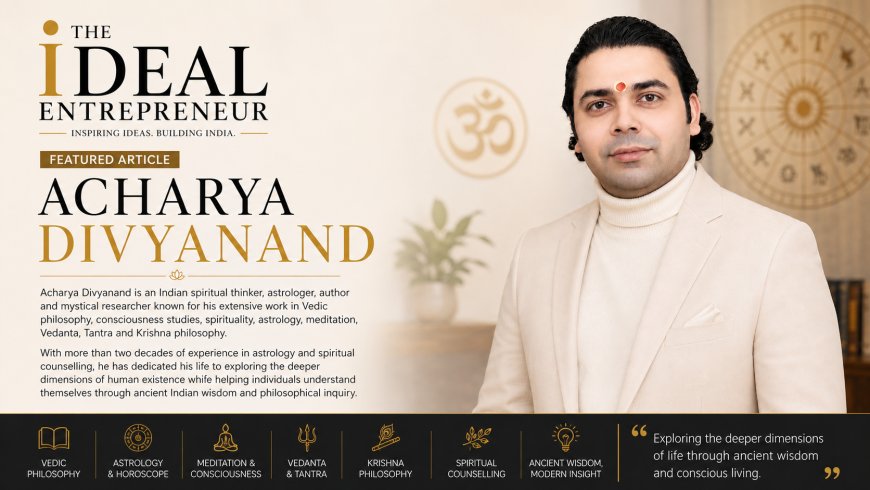
Acharya Divyanand: The Seeker Behind 100+ Books on Consciousness, Spirituality & Mysticism
Featured in The Ideal Entrepreneur – August Edition
Some journeys are measured by milestones. Others are measured by questions.
For Acharya Divyanand, the journey has been shaped by questions that have occupied human beings for centuries: Who am I? What is consciousness? Is destiny fixed? Why do we suffer? Can awareness transform the direction of life? What lies beyond what we can see?
A spiritual thinker, astrologer, author and mystical researcher, Acharya Divyanand has spent more than two decades exploring these questions through spirituality, astrology, Vedanta, Krishna philosophy, Tantra, meditation, human psychology and mystical traditions.
With 100+ books to his name, his literary journey reflects a continuing effort to examine the relationship between ancient Indian wisdom and the experiences of modern human beings.
His work does not simply ask people to believe.
It encourages them to question, observe, contemplate and understand.
A Journey That Began With Questions
Every meaningful journey begins somewhere.
For Acharya Divyanand, it began with questions that ordinary explanations could not fully answer.
Questions about identity.
Questions about suffering.
Questions about destiny and free will.
Questions about the mind and consciousness.
Questions about relationships, desire, fear and the meaning of existence.
Rather than treating these questions as problems that needed quick answers, he began approaching them as subjects of inquiry.
This became the foundation of his work.
For him, spirituality is not merely something inherited through tradition. It can also become a personal exploration of awareness and experience.
That distinction has remained central to his philosophy.
“Spirituality should not be approached only as something to believe. It can also be approached as something to investigate.”
From Belief to Understanding
In an age of instant information, people can access thousands of opinions within seconds.
Yet information does not necessarily create understanding.
A person can know about spirituality without experiencing it.
They can read about meditation without developing awareness.
They can study philosophy without examining their own mind.
Acharya Divyanand's approach places emphasis on the difference between belief and understanding.
Belief can be inherited.
Understanding requires observation.
It requires questioning.
It requires personal reflection.
This philosophy is reflected throughout his writing and counselling work, where the objective is not simply to provide conclusions but to encourage deeper self-inquiry.
The Author Behind 100+ Books
One of the most distinctive aspects of Acharya Divyanand's journey is the breadth of his literary work.
With more than 100 books, his writing explores an extensive range of subjects, including:
- Krishna and the Bhagavad Gita
- Vedanta
- Shiva consciousness
- Tantra
- Meditation
- Astrology
- Destiny and free will
- Consciousness
- Human psychology
- Relationships
- Love
- Self-realisation
- Mysticism
- Death and reincarnation
- The nature of reality
His books approach these subjects through different formats and perspectives.
Some are philosophical.
Some are reflective.
Some explore spiritual traditions.
Others examine relationships, psychology and the human experience.
The subjects may differ, but the underlying objective remains consistent: to explore the questions that shape human existence.
Krishna, the Bhagavad Gita & the Philosophy of Action
Krishna and the Bhagavad Gita occupy an important place in Acharya Divyanand's literary exploration.
His works include titles such as My Krishna, My Gita, The Secret of Krishna's Wisdom, The Art of Being Krishna, Krishna: Autobiography of an Era and Mind, Maya, and Madhav.
His interest in Krishna extends beyond historical interpretation.
The Gita raises questions that remain relevant to modern life:
What is our responsibility?
How should we act when choices are difficult?
How should we deal with attachment?
What is the relationship between action and consciousness?
How can a person navigate uncertainty without losing clarity?
These questions remain relevant because human psychology continues to experience many of the same struggles despite technological and social change.
For Acharya Divyanand, ancient wisdom becomes meaningful when it can engage with the questions of the present.
Exploring Shiva, Transformation & the Unknown
Shiva is another recurring subject in Acharya Divyanand's work.
His books include I Have Chosen Shiva, The Dream of the Third Eye, Shiva in the Cremation Ground, Tandava: The Mystery of Creation and Destruction, and The Great Void: Where Shiva Manifests.
Through these themes, he explores ideas of creation, destruction, transformation, silence, consciousness and the unknown.
Destruction, in this philosophical context, does not necessarily represent something negative.
Sometimes old identities must disappear.
Old patterns must be recognised.
Old assumptions must be questioned.
Transformation often requires something to change before something new can emerge.
This makes Shiva an enduring subject for philosophical reflection.
Astrology as a Language of Possibilities
Astrology is another major area of Acharya Divyanand's work.
However, his perspective extends beyond the simple idea of predicting future events.
He approaches astrology as a language through which people can examine patterns, tendencies and possibilities.
A horoscope, in this framework, does not necessarily become a rigid declaration of what must happen.
Instead, it can become a tool for reflection.
This distinction is important because it places personal awareness and responsibility alongside astrological interpretation.
The question is not only:
“What will happen?”
It is also:
“How will I respond?”
Destiny & Free Will
One of the oldest philosophical questions is whether human life is predetermined or shaped through personal choice.
Acharya Divyanand approaches this question through the relationship between circumstances and awareness.
Life presents circumstances.
People experience tendencies.
But awareness influences how individuals respond.
And choices influence actions.
Actions can influence direction.
From this perspective, astrology does not need to create helplessness.
Instead, it can encourage greater awareness of one's patterns and decisions.
The deeper purpose is not to become afraid of destiny.
It is to become more conscious of the present.
Spiritual Counselling & Self-Understanding
Alongside writing and research, Acharya Divyanand has spent more than 20 years involved in astrology and spiritual counselling.
People often seek guidance during periods of uncertainty.
Career decisions.
Relationships.
Marriage.
Family situations.
Personal transitions.
Spiritual questions.
Major life choices.
But his philosophy of counselling goes beyond simply providing an answer.
The deeper objective is to help an individual understand their own situation more clearly.
“Counselling should not create dependency. The deeper purpose is to help people see their own situation more clearly.”
This approach places self-understanding at the centre.
The counsellor may provide perspective.
But the individual ultimately has to make the decision.
Mysticism as an Investigation of Consciousness
Acharya Divyanand's identity as a mystical researcher is closely connected to his interest in consciousness.
His exploration includes Vedanta, Yoga, Tantra, meditation, Vedic thought, Krishna philosophy and other Indian spiritual traditions.
For him, mysticism is not simply about escaping reality.
It is about investigating reality more deeply.
What is the mind?
What is awareness?
What is the ego?
What is perception?
What happens when a person observes their own thoughts?
What does meditation reveal?
What does self-realisation mean?
These questions continue to shape his research and writing.
The Mind, Psychology & Spirituality
A distinctive feature of Acharya Divyanand's work is the connection between spiritual philosophy and human psychology.
Fear is psychological.
Attachment is psychological.
Desire is psychological.
Relationships are psychological.
Identity is psychological.
Suffering is psychological.
Even the way people interpret spiritual experiences is influenced by the mind.
This makes understanding psychology an important part of understanding spirituality.
His writing therefore explores the intersection between inner experience and philosophical thought.
Why Modern People Continue to Search
Modern life offers more information, technology and material choices than previous generations could have imagined.
Yet the human search for meaning continues.
People still ask:
Why am I restless?
What will make me fulfilled?
Why do relationships create suffering?
Why does success sometimes fail to create peace?
What do I actually want?
Who am I beneath my social identity?
For Acharya Divyanand, these questions help explain why spirituality continues to remain relevant.
Material progress can solve many external problems.
But external progress does not automatically resolve every internal question.
That is where self-inquiry begins.
Exploring Love, Relationships & Human Desire
Another significant area of Acharya Divyanand's writing explores relationships, love, desire and human psychology.
His works include titles such as Woman: An Unanswered Question, Woman and the Subconscious Mind, Shakti: The Essence of Existence, Woman: The Center of Tantra, Lover and Wife: Two Faces of Love, The Spiritual Lover, The Beloved, Love Is the Answer and The Spiritual Language of Touch.
These works reflect his interest in examining relationships not simply as social arrangements, but as experiences involving psychology, attachment, identity, desire and consciousness.
For him, difficult subjects are still part of human existence.
Understanding them requires the willingness to examine them honestly.
Tantra & the Search for Deeper Understanding
Tantra represents another important area of Acharya Divyanand's research and writing.
His work explores subjects related to Shakti, consciousness, relationships, desire, psychology and the feminine principle.
He approaches Tantra as a complex philosophical and spiritual tradition rather than reducing it to a single popular interpretation.
The broader objective is to explore its symbolism, psychology and philosophical dimensions.
This reflects a recurring feature of his approach: ancient traditions should be studied deeply rather than reduced to simplistic explanations.
Death, Reincarnation & the Meaning of Life
Death is perhaps the ultimate question of human existence.
Acharya Divyanand explores the subject through works including Death: The Ultimate Truth and The Truth of Reincarnation.
For him, thinking about death does not necessarily mean becoming pessimistic.
It can create awareness of life.
People often live as though time is unlimited.
Important conversations are postponed.
Personal growth is postponed.
Meaningful experiences are postponed.
Awareness of mortality can change priorities.
It can remind people that life is finite and therefore worth experiencing consciously.
Meditation & the Observation of the Mind
Meditation plays an important role in Acharya Divyanand's exploration of consciousness.
The mind is normally experienced from within.
Thoughts appear and are immediately followed by reactions.
Through meditation, however, a person can begin to observe thoughts rather than automatically identifying with them.
A thought exists.
An emotion exists.
But awareness can observe both.
That distance can become meaningful.
It creates space between thought and reaction.
And within that space, greater awareness can develop.
From Astrology to Awareness
Although astrology, psychology, meditation and spirituality may appear to be separate subjects, Acharya Divyanand's work connects them through a common theme:
self-understanding.
Astrology examines patterns.
Psychology examines the mind.
Meditation develops observation.
Spirituality explores consciousness.
Writing creates a space for inquiry.
Counselling encourages reflection.
Together, they become different pathways toward a deeper understanding of the individual.
The Philosophy of Asking Better Questions
Perhaps the most defining characteristic of Acharya Divyanand's work is his relationship with questions.
He does not treat every question as something that requires an immediate final answer.
Sometimes the question itself can transform the person asking it.
A question about suffering can lead to self-observation.
A question about destiny can lead to responsibility.
A question about consciousness can lead to meditation.
A question about death can change the way a person understands life.
A question about identity can begin the journey toward self-inquiry.
In that sense, questioning becomes part of the spiritual journey.
A Literary Journey That Continues
With more than 100 books already written, Acharya Divyanand's literary journey continues to evolve.
His subjects may move from Krishna to Shiva, from astrology to psychology, from Tantra to meditation, from love to death, and from destiny to consciousness.
But underneath these subjects lies one continuing inquiry:
What does it mean to be human?
That question may never have a single final answer.
Perhaps it is not supposed to.
For Acharya Divyanand, the journey itself is meaningful.
The Vision Ahead
Looking ahead, Acharya Divyanand's work remains focused on creating a deeper dialogue between ancient Indian wisdom and contemporary human experience.
His vision is not simply to preserve philosophical ideas as historical concepts.
It is to explore how those ideas can engage with modern questions about identity, psychology, relationships, consciousness, purpose and existence.
As technology changes the external world, the inner questions of humanity continue.
And those questions create an enduring space for philosophy, meditation, spirituality and self-inquiry.
The Ideal Entrepreneur Perspective
Entrepreneurship is often associated with companies, investments, growth and commercial success.
But there are other forms of entrepreneurship—forms built around ideas, knowledge, intellectual exploration and human transformation.
Acharya Divyanand's journey represents this broader interpretation.
He has built a substantial literary body of work.
He has spent more than two decades exploring spirituality and astrology.
He has developed a distinct voice around consciousness, Indian philosophy and mystical research.
And he continues to encourage people to examine their own lives through questions rather than simply accepting inherited answers.
His journey reminds us that meaningful influence does not always come from building a conventional business.
Sometimes it comes from building a body of knowledge.
Sometimes it comes from starting a conversation.
Sometimes it comes from giving people a question they had never thought to ask.
A Legacy Built Around Inquiry
The greatest legacy of a thinker may not be the number of answers they provide.
It may be the number of people they encourage to think differently.
Acharya Divyanand's work is ultimately an invitation to look inward.
To question.
To observe.
To understand.
To become more conscious of the mind, relationships, choices and the experience of being alive.
His journey is still unfolding.
The books continue.
The questions continue.
The inquiry continues.
And perhaps that is the most authentic expression of a seeker.
Not claiming to have reached the final answer—
but remaining willing to ask the next question.
Featured Personality
Acharya Divyanand
Spiritual Thinker | Astrologer | Author | Mystical Researcher
20+ Years of Experience in Astrology & Spiritual Counselling
Author of 100+ Books
Researcher of Indian Philosophy, Mysticism & Consciousness
Featured in The Ideal Entrepreneur – August Edition
Question. Observe. Experience. Understand.
— The Ideal Entrepreneur Editorial Team