Shekhar Khomne: Teacher, Numismatist & Heritage Collector
Meet Shekhar Khomne, Maharashtra's educator and collector who has organized 20 exhibitions, preserving coins, currencies, stamps, books, minerals, and Indian heritage for students.
 admin
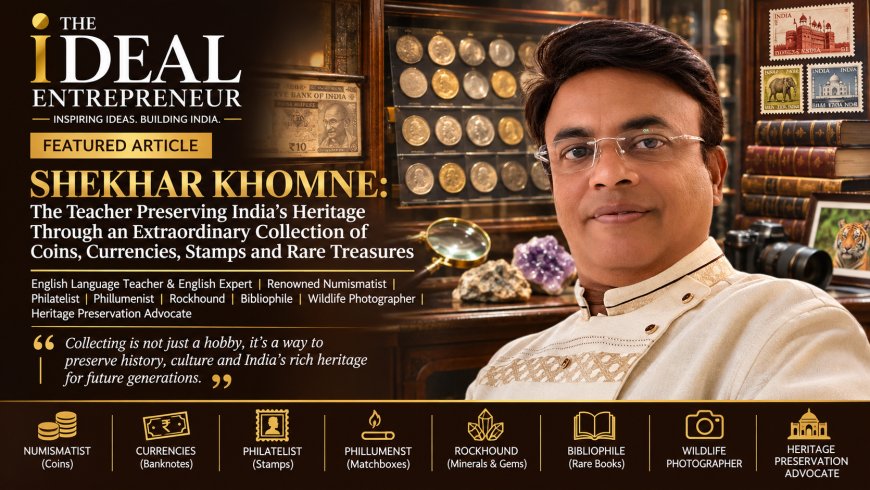
Shekhar Khomne: The Teacher Preserving India's Heritage Through an Extraordinary World of Collectibles
English Language Teacher | Numismatist | Philatelist | Wildlife Photographer | Philumenist | Rockhound | Bibliophile
From a small village in Maharashtra to 20 exhibitions across educational institutions, Shekhar Khomne has transformed a personal passion for collecting into a mission to educate young minds. Through rare coins, historic currencies, postal stamps, matchbox labels, minerals, wildlife photography, and an extensive personal library, he is bringing history, culture, and the wonders of the natural world closer to students.
A Teacher with a Mission Beyond the Classroom
In a small village like Pimpalgaon Raja in Maharashtra, extraordinary stories of knowledge, dedication, and curiosity can emerge from the most unexpected places. One such story belongs to Shekhar Khomne, an English language teacher and English expert whose passion for education extends far beyond textbooks and traditional classroom lessons.
For him, teaching is not limited to explaining a chapter, preparing students for examinations, or completing a prescribed syllabus. It is about opening doors to discovery, encouraging questions, and giving young people opportunities to experience the world beyond their immediate surroundings.
An educator by profession and a collector by passion, Khomne has developed an exceptional collection spanning Indian and foreign coins, currencies, postal stamps, matchbox labels, books, minerals, and crystals. His interests also extend to wildlife photography, through which he has captured the beauty of local birdlife in Maharashtra.
What makes his journey particularly meaningful is the purpose behind these collections. Rather than keeping valuable objects stored away for personal enjoyment, he has taken them to educational institutions, organizing 20 exhibitions in different colleges and giving students an opportunity to explore objects that many may never otherwise encounter.
His guiding belief is simple: knowledge and heritage should be shared. Valuable collections should not remain hidden in trunks when they can become instruments of education and inspiration.
The Classroom Moment That Started a Remarkable Collection
Every meaningful journey has a beginning. For Shekhar Khomne, the inspiration for collecting coins emerged from an unexpected source: an English-language school textbook.
While teaching a Grade 8 lesson, he came across a description of British India coins. The subject immediately attracted students' attention. They wanted to understand what those coins looked like, how they were used, and what made them historically significant.
However, the illustrations in the textbook were not sufficiently clear to satisfy their curiosity.
Khomne recognized an important educational opportunity. Students were interested in history, but they needed something more tangible than small or unclear printed pictures. They needed to see actual coins, observe their designs, examine their inscriptions, and understand how currency had evolved over different periods.
That classroom experience inspired him to begin building his own coin collection.
What started as an effort to make one lesson more engaging gradually developed into a serious collecting pursuit. His interest expanded beyond British India coins to ancient Indian currency, princely-state issues, medieval coins, modern coins, commemorative editions, foreign currency, and unusual minting errors.
The collection became much more than a personal hobby. It became a practical educational resource through which history could be brought to life.
A Numismatist Preserving Centuries of Monetary History
One of Khomne's most significant areas of interest is numismatics—the study and collection of coins.
His collection includes approximately 1,100 Indian and foreign coins, representing different historical periods, political systems, artistic traditions, and monetary developments.
Among its notable highlights are coins dating back to the sixth century BC, giving the collection a connection to some of the earliest traditions of monetary exchange in the Indian subcontinent.
The collection includes several important categories:
-
Ancient Coins: Coins associated with early historical periods, including examples dating to the sixth century BC.
-
Punch-Marked Coins: An important category of early Indian coinage, distinguished by symbols impressed onto metal pieces.
-
Princely-State Coins: Currency associated with India's former princely states and their individual monetary traditions.
-
British-Era Coins: Coins from the period of British rule in India.
-
Medieval Coins: Currency representing monetary traditions from different medieval periods.
-
Modern Coins: Coins reflecting more recent developments in Indian and international currency.
-
Commemorative Coins: Special issues created to recognize significant people, events, and occasions.
-
Silver Coins: Including a ₹100 silver coin.
-
Special Commemorative Issues: Including a ₹75 coin.
-
Error Coins: Unusual minting examples, including planchet errors and off-center strikes.
Each category offers a different opportunity to explore history.
A coin can reveal more than its monetary value. Its metal, symbols, inscriptions, dimensions, and design can provide clues about the period in which it was produced and the authority that issued it. Coins also offer an engaging way to introduce students to historical timelines, political changes, trade, culture, and artistic expression.
For Khomne, displaying these objects allows students to experience history through observation rather than relying entirely on written descriptions.
Exploring the World Through 50 Countries' Currencies
Alongside coins, Khomne has built a collection of approximately 1,100 Indian and foreign currency items, representing around 50 countries.
Banknotes are fascinating historical and cultural documents. Their designs often feature national leaders, historical personalities, monuments, wildlife, architecture, traditional art, and symbols of national identity.
By collecting currencies from different countries, Khomne has created an opportunity to introduce students to the wider world through objects they can hold and examine.
A currency exhibition can become a journey across borders. Students can compare colours, languages, portraits, symbols, denominations, and security features while learning about the countries represented.
For students from a village such as Pimpalgaon Raja, this exposure can be especially valuable. It allows them to explore international cultures and geography through a collection assembled by someone from their own community.
The collection demonstrates how an ordinary object used in everyday transactions can also become a window into history, identity, and global diversity.
Philately: Preserving the Stories Behind Postal Stamps
Khomne's interest in collecting extends to philately, the study and collection of postage stamps.
His postal-stamp collection includes approximately 1,500 stamps representing around 60 countries.
Stamps may be small in size, but they often carry remarkable stories. They commemorate national events, famous personalities, cultural traditions, scientific achievements, historical milestones, and natural heritage.
A collection of stamps from different countries can become a visual archive of the world.
For students, examining stamps provides opportunities to discover unfamiliar nations, recognize important historical figures, understand national symbols, and develop an interest in geography and international culture.
Through his philatelic collection, Khomne demonstrates that learning does not always require large displays or complicated technology. Sometimes, a small piece of printed paper can introduce a student to an entirely new subject.
Philumeny: An Unusual Collection of Matchbox Art
Among Khomne's most distinctive collecting interests is philumeny—the collection and study of matchbox labels and matchbox-related material.
His treasure includes approximately 1,000 matchbox pictures, including examples associated with Tunisia, Sri Lanka, and Vietnam.
Matchbox labels are often overlooked after their original purpose has been served. Yet their designs can reflect the visual culture, commercial creativity, printing styles, and everyday imagery of different countries and periods.
They can feature animals, plants, landmarks, illustrations, traditional patterns, company identities, and other cultural references.
By preserving these images, Khomne has created a collection that offers an unusual perspective on everyday design and visual history.
For young visitors, this collection can be especially surprising. An ordinary object that might otherwise be discarded becomes an opportunity to discuss art, design, international culture, and the history of printed materials.
It is another example of how curiosity can transform overlooked objects into meaningful educational exhibits.
A Rockhound's Fascination with Nature's Hidden Beauty
Khomne's interests also reach into the natural sciences through rockhounding—the collecting and appreciation of interesting rocks, minerals, and crystals.
His collection includes approximately 200 unique stones and crystals from six countries.
These specimens are notable for their distinctive shapes and natural formations. Their appeal lies in the remarkable variety of structures and appearances created through geological processes.
For students, mineral and stone collections can provide a visual introduction to geology and the natural world. They encourage questions about how rocks form, why minerals have different colours and textures, and how geological processes shape the Earth's surface.
A collection of stones from different countries also provides an opportunity to introduce geographical diversity and the relationship between natural resources and the landscapes in which they are found.
Khomne's interest in rockhounding reflects a broader spirit of observation: looking closely at the world, recognizing details that others might overlook, and preserving objects that inspire curiosity.
Wildlife Photography: Capturing Maharashtra's Local Birdlife
Beyond historical objects and physical collections, Khomne has developed an interest in wildlife photography.
He has captured colourful photographs of approximately 40 local bird species found in Maharashtra.
Birds are an important part of the natural environment, and observing them can introduce students to biodiversity, habitats, behaviour, and ecological awareness.
Wildlife photography requires patience, observation, and an appreciation of small details. A successful photograph often depends on understanding the subject, recognizing its environment, and waiting for the right moment.
Through his bird photographs, Khomne offers another form of learning—one that connects students with the living world around them.
The collection also highlights the importance of observing local biodiversity. Students do not always need to travel to distant forests or wildlife reserves to develop an interest in nature. Their own surroundings can provide opportunities to discover and appreciate different species.
His photography brings these moments into an educational setting, allowing students to observe the colours and beauty of birds through carefully captured images.
A Bibliophile with a Personal Library of Knowledge
Books have always held an important place in education, but for Khomne, collecting books is also a way of building a permanent resource for learning.
As a bibliophile, he has developed a personal English-language library containing approximately 1,000 books.
The collection includes encyclopedias, reference books, and 34 dictionaries, making it a substantial resource for language learning and general knowledge.
His personal library is maintained at his home, where students from nearby villages can make use of the available books.
This aspect of his work is particularly significant because access to reference material can influence a student's educational development. Students who have access to dictionaries, encyclopedias, and other reference books can strengthen their vocabulary, improve reading habits, explore subjects independently, and develop greater confidence in learning.
For an English language teacher, dictionaries are especially valuable. They help students understand meanings, pronunciation, spelling, usage, and the relationships between words.
By maintaining a personal library and allowing students from villages to benefit from it, Khomne extends his educational contribution beyond the formal school environment.
His library represents a simple but powerful idea: knowledge becomes more valuable when it is made accessible to others.
Twenty Exhibitions: Taking Heritage Beyond the School Walls
Perhaps the most inspiring part of Khomne's journey is his decision to take his collections directly to students.
He has organized 20 exhibitions at different colleges, creating opportunities for young people to see and learn from his collections.
The central purpose behind these exhibitions is to make valuable historical, cultural, and natural objects accessible to students from other schools and colleges.
He believes that collections should not remain hidden in storage. Coins, currencies, stamps, and other objects have educational value when students can observe them, compare them, ask questions, and understand their significance.
The exhibitions bring together several areas of knowledge under one roof:
-
History through ancient, medieval, British-era, and modern coins.
-
Geography through currencies and stamps from different countries.
-
Art and culture through matchbox labels and postal designs.
-
Science through stones, minerals, and crystals.
-
Environmental awareness through wildlife photographs.
-
Language and general knowledge through dictionaries and reference books.
This multidisciplinary approach makes the exhibitions especially meaningful.
A student visiting the exhibition to see a rare coin might discover an interest in history. Another might become fascinated by foreign currencies, while someone else may find inspiration in the bird photographs or mineral collection.
The exhibitions create an environment in which learning happens through discovery.
Preserving Indian Heritage for the Next Generation
Khomne's mission is closely connected to the preservation and promotion of Indian heritage.
Coins and currencies are not merely objects of exchange. They are part of a country's historical memory. They reflect changing governments, economic systems, cultural identities, artistic traditions, and technological developments.
Similarly, stamps preserve moments in national and international history, while books safeguard knowledge and natural specimens encourage appreciation of the Earth's diversity.
By collecting these objects and presenting them to students, Khomne is contributing to a culture of learning that values preservation and curiosity.
His work also carries a message for future generations: heritage should not be appreciated only through photographs or written descriptions. It should be explored, understood, preserved, and shared.
His decision to organize exhibitions outside his own school is especially important. It allows students from different institutions to benefit from the collection, extending its educational value beyond a single classroom.
The Importance of Learning from a Small Village
Pimpalgaon Raja, where Khomne lives and where his school is situated, is a small village in Maharashtra.
The setting makes his contribution particularly meaningful.
In smaller communities, access to specialized exhibitions, large reference libraries, and unusual educational collections may be limited. Students may have curiosity and enthusiasm but fewer opportunities to encounter objects connected to distant countries, ancient history, or specialized fields of study.
Khomne's efforts help bridge that gap.
His exhibitions bring historical coins, international currencies, stamps, and other collections closer to students who may not otherwise have the opportunity to explore them.
His home library offers additional learning support to students from surrounding villages.
Together, these initiatives demonstrate how an educator can contribute to the intellectual life of a community through personal commitment and the resources he has built over time.
A meaningful educational contribution does not always begin with a large institution or extensive infrastructure. Sometimes, it begins with one teacher who recognizes an opportunity to help students learn differently.
Teaching English and Inspiring Curiosity
While his collections receive considerable attention, Khomne's professional identity remains rooted in education.
As an English language teacher and English expert at P M Shri Z P High School and Junior College, Pimpalgaon Raja, he works in the field of language education.
His approach to learning reflects an understanding that students engage more deeply when lessons connect with real experiences.
The story of his coin collection began with precisely such a moment: students wanted to understand what they were reading, and he found a way to bring the subject closer to them.
That experience captures an important principle of effective teaching. A teacher's role is not simply to deliver information but to recognize curiosity and create opportunities for students to explore it.
His interests across history, geography, philately, natural science, wildlife, and literature also reflect the value of lifelong learning.
Khomne has received national awards for his contribution to teaching, adding professional recognition to his wider educational and collecting pursuits.
A Collector, Educator, and Heritage Advocate
What distinguishes Shekhar Khomne is not simply the number of objects he has collected. It is the range of interests represented in his collections and the educational purpose behind sharing them.
He is a numismatist fascinated by coins and monetary history, a philatelist preserving stamps from around the world, a philumenist collecting matchbox pictures, a rockhound appreciating natural stones and crystals, a bibliophile building a library, and a wildlife photographer documenting local birdlife.
These interests may appear different, but they are connected by a common quality: curiosity.
Each collection offers a different way to understand the world. Each exhibition creates an opportunity for someone else to discover something new.
His journey also illustrates how personal hobbies can become meaningful community contributions when they are guided by a larger purpose.
A Legacy Measured in Knowledge Shared
For Shekhar Khomne, the true value of a collection is not measured only by its rarity or size. Its deeper value lies in the knowledge it can inspire and the people it can reach.
The coins preserve stories of the past. The currencies connect students with the wider world. The stamps introduce international history and culture. The matchbox pictures reveal overlooked forms of design. The stones and crystals encourage scientific curiosity. The bird photographs create an appreciation for biodiversity. The library makes knowledge accessible to students who wish to learn.
Through 20 exhibitions and his personal library, Khomne has turned his interests into opportunities for education and heritage awareness.
His journey is a reminder that teachers can influence society in many ways, including through the passions they pursue outside their classrooms.
From a small village in Maharashtra, he is showing students that history can be held in the palm of a hand, that the world can be explored through a banknote or a postage stamp, and that even an ordinary matchbox picture can hold a story worth preserving.
Shekhar Khomne's story is ultimately about more than collecting. It is about preserving, sharing, and inspiring—ensuring that the treasures of history, culture, nature, and knowledge find their way into the hands and minds of the next generation.
Because a collection becomes a true treasure when its knowledge is shared with the world.